
One thing that most field vibration analysts will become aware of is how the directional stiffness of a typical machine will manifest itself in vibration data. The typical horizontal machine train (driver and driven) is fastened down to a very rigid foundation, having little to no freedom of movement in the vertical plane. Although the machine components are bolted and welded to one another in the horizontal plane, there is nothing like the rigidity of the foundation preventing the movement of the machine frame in the horizontal plane. This being the case for most horizontal machine trains the vibration amplitude in the horizontal direction is typically higher than in the vertical direction. How much higher depends on the structural make-up of the machine. This is a tipoff to the savvy analyst who may notice a rise in the ratio of the vertical amplitude to the horizontal. When this happens, it usually means the machine has lost some stiffness in the vertical direction. This can be due to loose fasteners, cracked welds, or even compromised foundations.
by Mike Fitch CRL
Is your equipment considered a slow-running speed machine? If so, what speed do you consider slow? Is it 30 RPM? 60 RPM? 100? 200? 600?
No matter what you consider slow speed, the two most critical points to consider for slow running equipment are:
1) Does your vibration sensor (accelerometer) have the appropriate frequency range to measure low frequencies?
2) Does your vibration analyzer and/or online monitoring system measure down to those frequencies?
Unfortunately, some vibration analysis devices on the market are not truly capable of measuring slow-speed equipment and providing a true mechanical diagnostic analysis. These devices can actually create a reactive maintenance result that the device was supposed to prevent.
For example, a motor shop in South Texas had completed a rebuild of a 100 HP motor. The motor is used in the oil and gas industry. It has an average running speed of 30 RPM. The customer tested the motor on their motor test stand. As it was in its test cycle, the vibration was measured using a self-diagnostic vibration analyzer. The results and diagnostics the analyzer provided to the customer were “please replace bearing”. After several further tests running the motor on the test stand, the customer refused to accept those results and retested the motor using a VIBXPERT® II analyzer with machine templates designed for slow running machinery and a VIB 6.147 low-frequency accelerometer.
The final analysis revealed a high unbalance condition on the motor (11 mils peak-peak). The motor shop followed up with a balancing job (single plane) on the motor. The balancing was performed with the VIBXPERT II as well. Subsequent tests showed that the unacceptable low-frequency amplitude that had been observed (11 mils pk-pk) prior to performing the balance job had now disappeared. Final mechanical diagnostics showed no problems and the bearings were in proper condition. A balance report was printed and the motor was ready to leave the shop.
If you want to increase your uptime and availability and reach your financial goals, proper investment in Condition Monitoring and reliability will provide a positive return on your investment.
by Alex Nino CRL
In the Condition Monitoring (CM) world there are two types of instruments: toys and tools. A toy will be defined as an instrument that is used only a few times after it has been purchased. Perhaps it failed or is determined to be too inefficient or insufficient to do the job. The toy is then placed back on a shelf or forgotten in a drawer as it offers no worth to the end-user or the company. Sometimes that toy is traded in for a real tool or simply thrown away. On the other hand, a tool is an instrument that is used extensively every month and offers a real return on its investment. Granted, a tool can be more expensive than a toy, but the amount of money spent on a quality tool should be recouped quickly. In today’s economy money is very tight and a lot of decisions must be made before purchasing a CM instrument. The Latin phrase “caveat emptor” comes to mind when making such a purchase.
The internet allows for research to be done quickly on different CM instruments. This allows a potential buyer to discover what is a tool and what is a toy. A few things to consider when purchasing a CM instrument are:
1) How long has the provider been in the industry?
2) What kind of support is offered?
3) Does this support require additional fees to be paid or is it provided free of charge?
4) What type of training is required and available from the provider?
5) Where are any needed repairs performed?
6) Is loaner equipment available when calibration and repairs are required?
7) Can the instrument’s capabilities grow to meet your needs?
8) Does the instrument help us determine the root cause of our equipment reliability issues?
9) What is the real cost of ownership over the life of the instrument?
10) Does the instrument provide the true analytical capabilities needed?
by Mickey Harp CRL
As Published by BIC Magazine March 2013 issue
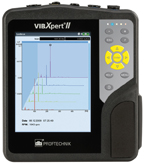 LUDECA’s VIBXPERT® II is exemplary of the company’s line of products designed to ‘Keep It Running.’ The slogan is indicative of what LUDECA’s condition monitoring solutions are committed to doing — keeping U.S. manufacturing running and productive.
The VIBXPERT II is a portable vibration analyzer with a full-color display, fast data acquisition, and powerful diagnostics tools. It combines the advantages of a rapid processor with a brilliant energy-efficient color VGA display. The diagnostic capabilities allow machinery reliability issues to be identified so corrective action can be taken to keep your equipment running and avoid unwanted downtime.
Ray Wonderly, the owner of Advanced Maintenance Technologies, purchased his first VIBXPERT from LUDECA in 2006 and upgraded to the VIBXPERT II in 2010 after being very satisfied with the company’s laser alignment systems (OPTALIGN PLUS) and customer service.
“Using the VIBXPERT II vibration system has substantially increased my business and customer base,” he explained. “It is a great selling point to my customers when I tell them I can take more vibration measurements and monitor more total equipment in less time because of the outstanding speed of the vibration analyzer itself without affecting the quality of vibration measurements.”
Wonderly found the “extras” LUDECA provides at no additional expense refreshing.
“Many vendors have it as a requirement that you purchase their additional and expensive maintenance support agreements in order to receive additional free firmware and software updates,” he explained. “LUDECA offers the highest quality system at the most affordable price — and with no additional support agreements — when compared to others.
“I have told many people if you just want a basic system at the absolute lowest price, LUDECA’s VIBXPERT may not be the best fit. But if you are looking for a top-of-the-line system at a fair price with many great features, the VIBXPERT is a great choice. You can buy it as more of a basic system and at a cheaper price and kind of grow into the many additional features as needed or required, such as the balancing or advanced diagnostics. The firmware is already built into the device and all you have to do after purchase is open it with the provided ID and password. You don’t have to send the system back for additional firmware features.
“In my personal opinion, LUDECA offers the highest quality system at the most affordable price and absolutely fantastic technical support. I truly feel you are getting more for your money as compared to some of the others.”
“At LUDECA, we maintain a high standard of ethics, service, and customer support by always striving to exceed customer expectations,” said Frank Seidenthal, president, LUDECA.
by Ana Maria Delgado, CRL
Every vibration analyst relies on accurate data to provide the necessary information to base a report or work order on that will set in motion the activities of the maintenance department. Therefore, the analyst must resist sinking into bad data collection habits. When early detection of a fault or possible problem is important (it usually is), the measurement contact point for a walk-around route should be clean down to the bare metal. A nice thick coat of paint is good at protecting against rust, but it’s not very good for transmitting vibration.
Trends are a very reliable tool for monitoring the condition of equipment IF the data points are taken exactly the same way time after time. The analyst must make sure that the amplitude and frequency changes are equipment-induced and not an analyst- or monitoring apparatus-induced. Sensor placement points should be clearly marked.
Many analysts take thousands of points each month and often don’t see the same discrete point again for at least a month. Don’t depend on memory to place your sensor.
Don’t play data roulette; force yourself into good data collection habits. The day will inevitably come when something seems to be wrong with your data and you will have to troubleshoot where the problem is. If you have disciplined yourself into meticulous habits, the troubleshooting will be much easier, and you can be much more confident in your day-to-day analysis.
by Mike Fitch CRL
This is Part 2 of a 2 part series, see Part 1 here.
After the proper groundwork has been completed, it is time to build the database for your CM technology. Read my article in IMPO Magazine which includes the last 5 Steps to Successfully Implementing a Vibration Program:
#6: Database structure
#7: Interfacing with other plant systems
#8: Build a database
#9: Create standard reports
#10: Get help
by Trent Phillips
This is Part 1 of a 2-part series.
Selection of a condition monitoring (CM) technology is not an easy task and requires that many concerns be taken into consideration. Determination of what functionality is needed, selection of a technology provider that can deliver the required technology, and an available budget are all critical considerations to think about before making a purchase. Otherwise, the intended results will not be found and the new CM technology will not provide value to the reliability efforts within your facility or corporation.
Management often fails to correctly consider how to successfully implement the CM technology once the selection has been made. The failure to consider beforehand how the CM technology should be implemented within their facility or corporation leads to:
- Increased labor
- Increased expense
- Living with the unsatisfactory results for a very long time
- Unsatisfactory results from the CM technology, including:
- Missed technology findings
- Lack of integration into the existing business process
- Inability to create standards
- Inability to generate meaningful reports
Read my article in IMPO Magazine which includes the first 5 Steps to Successfully Implementing a Vibration Program:
#1: Getting Started
#2: Do you already have a technology database available?
#3: Determine what equipment will be monitored
#4: Obtain required equipment information
#5: Create equipment templates
by Trent Phillips
WATER/WASTE PROCESSING • December 2012
Production plant analyzes resonance anomaly; looks at condition monitoring program as a profit center
Sometimes in industry, mechanical “circumstances” change. When it happens, a machine train identical to other machine trains can suddenly become atypical. This was exactly the case for Process Water Supply Pump A, whose behavior was very similar to that of its sister pump trains until something changed. In this article we discuss a problem that was abruptly encountered, the methods used to investigate it and the solution devised.
One of four identical pump trains mounted to a common piping system experienced a catastrophic motor (75 hp, 4 poles) failure. The motor could not be saved, and a new motor was purchased and installed. After installation, the pump was started with the new motor. High vibration caused the installers to immediately shut it down. The new motor had been laser aligned to the pump; therefore the alignment was not suspect; therefore vibration data was taken.
Read the entire article “Where is that vibration coming from“.
Thanks to Roger Earley with LUBRIZOL for sharing this case study with us.
by Ana Maria Delgado, CRL
Condition monitoring is the process of monitoring a parameter of condition in machinery, such that a significant change is indicative of a developing failure. Ironically most Condition Monitoring Programs often fail and here are some reasons why:
• Inappropriate use of “Low Tech” or “Low Priced” condition monitoring (CM) technologies
• CM technologies are purchased and results are magically expected to appear
• Use of “Part-Time” personnel for CM efforts
• Insufficient (or no) training provided initially and continually
• Do not establish certification criteria for employees
• Insufficient “LOA” (level of awareness) training to plant employees so that they understand the importance of CM efforts
• Failure to create sufficient collection schedules (routes)
• Apply CM technologies to a limited amount of plant equipment or the wrong equipment
• Over dependent upon a single CM technology
• Improper or outdated alarming criteria
• Improper utilization of the CM technology and software
• Improper database setup
• Poor documentation, reporting, and communication of the results
• No metrics to provide feedback
• No follow-up inspections on repaired equipment
• No acceptance inspections on new equipment, lubricants, etc.
When Condition Monitoring programs fail, equipment reliability fails too. Don’t let your program become another statistic or “flavor of the month”. Use proactive tools like Reliability Centered Maintenance or other techniques to develop a basis for the Condition Monitoring strategies you deploy. Work to ensure that the reasons listed above don’t become your reasons for failure. If you need help, please let us know because we measure our success on your success. What other items would you suggest to achieve and sustain success?
by Trent Phillips
Severity determination is one of the most difficult tasks a vibration analyst faces. Several methods can be used to help identify the severity of defects identified in vibration data.
One method is to consider the amplitude of the defect. This usually works well but does not always correctly identify the severity of the problem. Another method is to look at the G swing (peak-peak value) in the time waveform data that has been collected. An additional method is to trend the data and look for increases in trend values between data collection intervals. The rate of change shown in the trend data can be a very good indicator of the progression of the identified defect.
A combination of methods usually works best to help identify the severity of a defect. However, it is always best to report the defect condition for repair as soon as it has been identified. This provides as much time as possible to properly plan and schedule repairs as may be required.
by Trent Phillips
The Reliability Support Team at the Eastern Processing Facility located at Cape Canaveral Air Force Station, FL, won Uptime Magazine’s Best Design for Reliability Program award.

During the design phase of their program, the team was challenged with the implementation of Reliability-Centered Maintenance (RCM) principles and Precision and Predictive techniques from construction through commissioning. These have proven to be the most advantageous with regard to failure mode consequence reduction.
Congratulations to Frank Saukel, Garry Pell, and their team for this prestigious award and a job well done!
Program Highlights
1. Eastern Processing achieved Failure Mode Reduction with added redundancy.
2. They redesigned the facilities’ Reverse Osmosis Water System.
3. They performed Asset Prioritization based on safety, environmental, mission impact, and probability of failure studies.
4. They trained technicians and engineers on RCM. In the words of Garry Pell: “Don’t expect to gain tribal knowledge if you don’t invite them into the Teepee. Get your people involved from engineering to safety, from shipping to operations.”
6. They developed all maintenance procedures based on RCM decisions.
7. They identified the Predictive Maintenance (PdM) technologies and tools they needed, met with different vendors at different IMC Conferences, then focused, implemented, and trained on 1 or 2 maintenance and
Condition Monitoring (CM) technologies annually, including:
• Lubrication analysis
• Vibration analysis
• Laser shaft alignment
• Infrared thermography
• Ultraviolet thermography
• Electric signature analysis
• Ultrasound
Many discrepancies were corrected using these PdM and CM technologies. According to Frank Saukel, “Every one of the PdM technologies has paid for themselves.” For instance, they identified misalignment and motor structure resonance conditions using their VIBXPERT® vibration analyzer on several of their water pumps which had been aligned by a contractor.
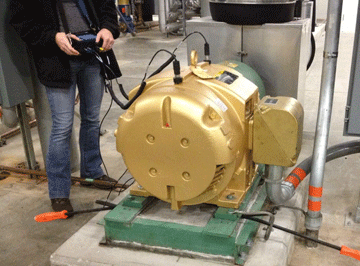
Every pump was found to be bolt-bound and base-bound. They realigned all their pumps to excellent tolerance with their ROTALIGN® ULTRA laser alignment tool.
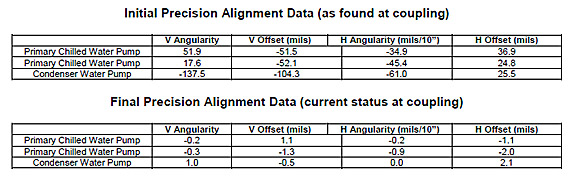
They also found and corrected electrical deficiencies with ultraviolet thermography and detected sub-grade piping leaks with ultrasound. Their precision lubrication program included oil analysis, with a resulting reduction in the number of lubricants, minimization of cross-contamination, and implementation of a color-coded system for easy machine identification and the use of accessories to control moisture. Learn more…
by Ana Maria Delgado, CRL
When performing an alignment on a machine train with a motor fitted with a sleeve bearing, it is important to account for the magnetic center of the motor. Failure to do so can cause excessive vibration and premature failure of motor components and the shaft coupling.
If the motor has recently been rebuilt it should come from the motor shop with a magnetic centerline scribed on the shaft. To properly set the shaft coupling gap do the following:
- Determine the correct coupling gap based on the manufacturer’s recommendation. (Note we refer here to the proper installation gap size and its tolerance, not the alignment gap tolerances for angularity.)• Identify the correct scribe mark on the shaft that represents the magnetic center.
- Measure the distance between the scribed mark and the outside bearing housing lip. In the case that the magnetic center scribe mark falls inside the motor housing while at rest, scribe a mark in the rest position.
- While the machine is un-coupled run the motor and estimate the difference between the newly scribed mark and the magnetic center mark. This is the distance that will need to be compensated for when setting the coupling gap.
- Set the coupling gap according to the manufacturer’s recommendation minus the distance measured for the magnet center correction if the mark is outside the bearing housing. Add the difference if the mark is inside the bearing housing. This will provide the proper coupling gap under the normal running condition.
by Ana Maria Delgado, CRL
 MEDIA RELEASE
The AHR Expo and its co-sponsors, ASHRAE and AHRI, have recognized our VIBCONNECT® RF wireless condition monitoring system with an HONORABLE MENTION in the BUILDING AUTOMATION Category of the 2013 AHR Expo Innovation Awards Competition. A panel of Industry Professionals, selected for their knowledge and expertise in HVACR, found our VIBCONNECT RF worthy of this recognition. Representing a broad cross-section of the HVACR marketplace, the winning entries were selected in 10 categories and represent the most innovative new products among the thousands that will be displayed at the show. A panel of judges made up of ASHRAE members evaluated the products submitted based on innovation, application, value to the user, and market impact.
Read the official AHR Expo Press Release.
Winners will be honored during the upcoming HVAC event, the 2013 AHR Expo, Dallas, TX – January 28-30. Register today for FREE exhibit hall pass.
by Ana Maria Delgado, CRL
We recently ran a poll to find out what the Top Machine Faults are for the attendees of the IMC-2012 International Maintenance Conference. Here are the results, which came from maintenance and reliability professionals who attended our Learning Lab:
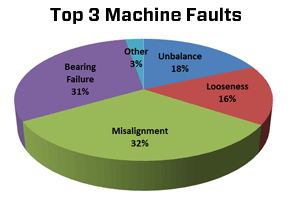
Misalignment: 32%
Bearing Failure: 31%
Unbalance: 18%
Looseness: 16%
Other: 3%
The good news is that all our lab participants were acquainted with our Condition-based Maintenance tools which can help them detect, prevent and correct all these problems.
It is essential to understand how equipment performs in a facility and to be able to identify these common machine reliability issues before they result in functional failures in your equipment. Payback technologies like vibration analysis, alignment, and balancing when part of a comprehensive condition monitoring program can improve your equipment performance, reduce equipment downtime and minimize risk.
by Ana Maria Delgado, CRL
Vibration analysis is the best all-around technology for diagnosing and predicting problems in rotating machinery. Over the years I have seen time and time again where adopters of this technology have saved themselves and their companies countless man-hours and thousands of dollars by getting to the root cause of a problem early on. By analyzing the data, they are able to schedule their valuable time on the right problem on the right machine long before the problem escalates into a major outage or emergency. But too many companies have not adopted vibration analysis. While it is true that one could spend many years learning the skills of the multiple levels of the vibration analysis disciplines, it is also true that even a basic understanding of the relationship between the time waveform and the spectrum can yield huge benefits and savings to a new user.
For example, the root cause of most roller bearing/seal failures is either shaft misalignment or rotor imbalance, which can take months to develop. It is also the most common problem analyzed within most facilities in the first two years of vibration analysis implementation. The good news is that misalignment and rotor imbalance are the easiest problems to diagnose by observing a high amplitude 1× running speed frequency in the spectrum. After that, a phase analysis with your analyzer can easily differentiate between misalignment or an imbalance problem and quickly completed without shutting down the machine.
We all know that Rome wasn’t built in a day but we all must start somewhere and just a few days in an analysis class could yield major benefits to new companies.
Thanks to Jay Gensheimer with Solute LLC for this valuable post.
by Ana Maria Delgado, CRL
It is All About the Cost!
We have all been there — It is about time to leave for the weekend on a late Friday afternoon, most of your maintenance staff has already left for the weekend, as you are getting ready to head out, all of the sudden someone runs up to you and says, “We have a problem, one of our assets just failed”. As you hurry off to assess the situation and mentally start thinking of who you can get in touch with to help rectify the situation, you cannot help but wonder to yourself, could this failure have been prevented?
Many people who are involved with the maintenance and operations of critical machine parts know of the benefits of a routine Predictive Maintenance Program and have often attempted to establish a Predictive Maintenance Program (PdM) within their facilities. The problem is, very rarely do the people who know the value of a PdM program have the ability to allocate the required budget to implement a PdM program, and without hard numbers, budgeting for a PdM program can be a hard sell. Here are some ways that one can use to help justify a PdM Program within your facility.
When businesses look at where to allocate their money, they do so with the hope of investing in things that will have the greatest return on investment (ROI). This is understandable because businesses are in business to turn a profit. Oftentimes, others outside of maintenance and operations do not understand the return they will see through a PdM program being implemented. However, with a well-established PdM program, companies can generally see their ROI in less than one year! And, in actuality, the ROI happens more typically within about 6 months’ time. That means the money that it costs to start a program is typically saved by the company within 6 months from implementation.
All plants will have a random failure, but a well-run PdM program will help detect and mitigate many of the potential problems and prevent many unplanned outages on critical assets. Unscheduled downtime is expensive and can result in safety or environmental incidents. Hidden costs from failures can include premium pay, the premium cost for non-stocked spares, and additional regulatory reporting.
Potential savings from a well-run PdM program also include reduced maintenance costs because intervals for periodic preventative maintenance shutdowns can be extended because you know the condition of the machine, and can decide that a PM is not required at the current interval. Also, since machine condition is better known, parts inventories can be reduced and the parts can be sitting on the vendor’s shelf instead of yours.
Put simply, if it costs $1 Million a week to run your plan, a breakdown that results in a plant outage can cost $6000 per hour in downtime plus the cost of repair, overtime, and premium costs of parts not in stock, environmental clean-up, etc. This does not include potential profit from lost sales.
Predictive Maintenance Programs offer the lowest cost with the highest savings for most plants and facilities. With a PdM program established maintenance will be able to detect when an asset is deteriorating ensuring that a spare is ordered and on hand. In addition, the repair can be scheduled during scheduled downtime, so there is no loss in production. In addition, if the company contracts out the PdM program, oftentimes your company can avoid the initial start-up costs associated with starting up a PdM program.
Thanks to our training partner Pioneer Engineering for allowing us to share this article with you.
by Ana Maria Delgado, CRL
Every vibration analyst knows that our failures are quickly publicized throughout the facility or corporation. It is amazing how quickly this type of information is transmitted. This is why most analysts develop a very thick skin or soon find another career path.
It is important to make sure that your successes are publicized as well. Management should support this effort to increase the awareness of the Condition Monitoring (CM) efforts in your facility. Save the bearings and other items that are removed from the equipment as a result of your CM efforts. Keep some of these items around your office to do a “show and tell” when people visit you to criticize your efforts. Consider creating a monthly or quarterly email or newsletter demonstrating your successes. Publicize your findings in an article or present the findings at a trade show. Be creative, but make sure that others are aware of the value that you and the CM technologies you utilize provide. Otherwise, you may find yourself and/or the CM group on the chopping block.
by Trent Phillips
Do you verify the quality of the maintenance work or installation that is completed on your equipment? You may be surprised to know that failure modes such as bearing defects, misalignment, etc., can be introduced into your equipment as a result of poor maintenance practices or installation work.
Condition Monitoring (CM) follow-up measurements should be completed after each maintenance repair on your machinery. This will allow you to verify that the equipment was repaired correctly and that no other failure modes were induced as a result of the repair effort or installation of the equipment.
It is a good idea to make CM follow-up measurements a part of the work order. This way the work order cannot be closed until a follow-up measurement with the CM technology (vibration analysis, oil analysis, ultrasonics, motor diagnostics, thermography, etc.) has been completed. This will help you ensure that your equipment was repaired correctly, installed correctly, and is truly ready for operation. This results in improved equipment reliability.
by Trent Phillips
Do your analysts use consistent phrases or statements when creating condition monitoring (CM) work orders? It is very important to convey concise and accurate information with each CM work order. Often times misspelled words, inaccurate information, or incomplete maintenance steps are included in work orders. A best practice is to determine the most common findings for a specific CM technology and determine what actions should be taken as a result. For example, if vibration analysis identifies unbalance in a fan, a recommendation should be made to clean the fan prior to attempting to balance it. If a CM technology identifies a failure that requires the machine to be removed, then re-alignment may be necessary before the machine is placed back into service. All of these steps and perhaps additional steps should be conveyed by the CM analyst creating the work order.
Creating consistent and detailed steps for common CM problems will avoid forgetting to convey important information to those doing the work. This will help ensure that best practice maintenance is completed on your equipment, things are not forgotten, misspelled words entered, or other common mistakes made.
by Trent Phillips
WATERWORLD • September 2012
The water treatment facility in the City of Fairfield, Ohio, uses vibration analysis as part of its condition-monitoring planned/predictive maintenance program to help verify and assure equipment is operating satisfactorily. The Water Treatment Plant processes an average 5.1 mgd for a population of 44,000 people with a customer base of approximately 14,000 accounts.
Public Utilities Superintendent Andreas Eddy initiated the vibration analysis program as part of a cost-savings measure with regard to the “total” operating cost of equipment associated with the water treatment process. The intent was to identify potential equipment problems at an early stage and to allow maintenance work to be performed on a proactive basis.
Vibration data was collected with the VIBXPERT® 2-channel vibration analyzer and plotted with OMNITREND® software by Prueftechnik/Ludeca. The system helped identify a “Severe Mechanical Looseness” problem on a pump installed at a pumping station considered critical to the city’s water system.
Read the entire article Vibration Analysis Helps Identify Pump Problem
Thanks to Ray W. Wonderly of Advanced Maintenance Technologies for sharing this case study with us. Special acknowledgment to Andreas Eddy, Superintendent of Water Treatment Operations for co-authoring and approving this case study.
by Ana Maria Delgado, CRL