The water treatment facility in the City of Fairfield, Ohio, uses vibration analysis as part of its condition-monitoring planned/predictive maintenance program to help verify and assure equipment is operating satisfactorily. The Water Treatment Plant processes an average 5.1 mgd for a population of 44,000 people with a customer base of approximately 14,000 accounts.
Public Utilities Superintendent Andreas Eddy initiated the vibration analysis program as part of a cost-savings measure with regard to the “total” operating cost of equipment associated with the water treatment process. The intent was to identify potential equipment problems at an early stage and to allow maintenance work to be performed on a proactive basis.
Vibration data was collected with the VIBXPERT® 2-channel vibration analyzer and plotted with OMNITREND® software by Prueftechnik/Ludeca. The system helped identify a “Severe Mechanical Looseness” problem on a pump installed at a pumping station considered critical to the city’s water system.
Thanks to Ray W. Wonderly of Advanced Maintenance Technologies for sharing this case study with us. Special acknowledgment to Andreas Eddy, Superintendent of Water Treatment Operations for co-authoring and approving this case study.
Many facilities have placed overall vibration data collection devices in the hands of their operators. The goal is to give the operators and production a tool to help identify equipment problems and the severity of those problems.
The intent of this effort is very good. However, the true value of this effort is usually not understood.
First, generic overall vibration levels can be quite dangerous if not fully understood. Secondly, the actual value of having operators collect vibration data is not usually taken advantage of fully.
Overall vibration levels require the same amount of time for data collection as is required to collect very detailed vibration information on the equipment. Therefore, the operator should actually collect the overall vibration levels they need while simultaneously collecting detailed information for the vibration analyst to review. What happens if the operator collects an overall vibration level on a machine and some problem is suspected? The facility has to invest time and effort for an analyst to revisit the machine and collect enough vibration data to actually verify and analyze the problem. This means that additional labor is required or the results are diminished. With the correct vibration hardware, the operator can easily collect the overall vibration values they need as well as the detailed information the analyst needs. This saves time and money. What if the activity occurs after hours? The detailed data collected by the operator could be remotely passed on to the analyst for detailed evaluation. This saves time and greatly improves the response time from employees and the technologies. Operators could be used to easily and routinely collect vibration data on much of the equipment for analysis by the vibration group. This would allow greater equipment coverage by the vibration analysis program, allow the analyst to focus on analysis, and spend less time collecting data.
To summarize, having the operator collect vibration data can be of great value if done the correct way, otherwise, the process can provide inaccurate information and reduced benefits.
By James Laxson, Hi-Speed Industrial Services in collaboration with Mike Fitch, LUDECA, Inc.
In May 2010, an electric motor repair service provider in Little Rock, AR, began a condition monitoring program for a new customer. The customer opted for quarterly data collection.
Read the article Pump Train Component Failure, a briefcase history of a component failure in a nominal 1,800 RPM pump train.
Setting the proper LOR is essential to be able to separate closely spaced defect frequencies. An example would be a pump with 5 vanes that could generate a “Vane Pass” frequency equal to the number of vanes, or 5 times rotational speed; if the impeller end of the pump had an SKF 7301BEP bearing, it could have an inner race defect frequency of 4.99 times running speed. This combination would require a relatively high resolution or LOR in order to have enough detail to separate the defect frequencies of each defect.
Overall values are the most common measurements and calculations used in vibration analysis. The purpose of this measurement and calculation is to identify changes in the condition of the equipment being measured.
Overall measurements are an important tool for the vibration analyst. However, generic overall values can actually be deceptive if their limitations are not fully understood. Typically, overall vibration values are measured and a calculation based upon the entire frequency range is measured with the vibration data collector.
It is possible for certain frequencies to increase while other frequencies decrease. This is important because these changes are indications of specific machine conditions. The overall value could actually decrease or change very little and give a false indication of the machine’s health.
Band alarms and band analysis is the best vibration method to indicate changes in the condition of your equipment. Specific bands can be easily created, measured, and trended around the specific failure modes in the equipment such as bearings, misalignment, unbalance, and many more. This type of information can alert you much more accurately of failure conditions in your equipment versus generic overall measurements and calculations.
An air conditioning and heating systems manufacturer in Texas is challenged to continue providing the industry with leading products, while meeting high-reliability standards, maintaining affordable prices, and meeting increasing worldwide demand for the products they manufacture. All of this must be done in a way that provides the expected financial return for stakeholders. An internal evaluation was completed to determine how to achieve and continually meet these goals. It was determined that the negative consequences of unplanned downtime, high production costs, inability to increase production capacity and product quality issues were putting these goals at risk. The goal of the facility is to maintain equipment uptime and availability at greater than 90%.
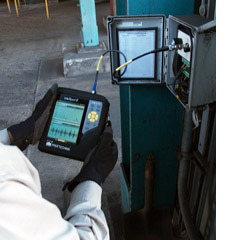
The final analysis revealed that additional reliability efforts would reduce the risk factors preventing the achievement of their business goals. As a result, the company understood that an investment in Condition Monitoring was required. Consequently, an investment in our VIBXPERT® II portable and VIBNODE® online vibration analysis systems was made. The company decided to install permanently mounted sensors due to equipment accessibility issues. A LUDECA CM Engineer completed a start-up and commissioning process to help maximize the return on this effort for the customer. The OMNITREND® software and vibration analysis equipment provided by LUDECA has already enabled the facility to identify a number of bearing problems and other reliability issues preventing their goals from being achieved.
Does your company have the same challenges and results expectations as those described above? What is your facility doing to improve reliability, product quality, production capacity, and the financial return for stakeholders? How does your company mitigate risk factors that prevent your goals from being achieved? A proper investment in Condition Monitoring and reliability-centered efforts will continually provide a positive return on the investment. This will help your company achieve positive financial and competitive goals like the company above.
One of the most overlooked features of a good vibration data collector is the ability to enter important process information such as temperatures, pressures, equipment lubrication levels, equipment speed, and much more.
Documentation of process data is important for your production department. This information is important to the Condition Monitoring (CM) Analyst as well. Changes in process data may explain why the vibration amplitude levels or other CM conditions have changed.
Many facilities struggle with the ability to record and store process-related data. A good vibration data collector will have the ability to record and store this type of information. In fact, routes can be created for operators to guide them through the routine acquisition of this information. Vibration data can be acquired by the operators as well. This could provide additional value-added time in your facility.
This data can be easily stored to meet the documentation requirements of your facility and trended to provide increased analysis opportunities that may otherwise go overlooked.
It is common knowledge that it is critical to document the financial savings that result from Condition Monitoring (CM) activities such as vibration analysis. It is also common knowledge that it is often difficult to get management to provide routine funding for additional CM technologies and/or related training. Have you considered the possible value in documenting the financial costs associated with failures? You can use this information to demonstrate to management the cost of not providing additional technologies and/or related training.
Management may not be aware of the cost of doing nothing, or of doing too little.
Document the failures you could have identified if an additional CM technology was available or additional training had been provided. Show management that the cost of doing nothing is much higher than they may suspect. They may be surprised that not providing funding for CM technologies and training is actually costing them much more than investing in such efforts. You may be surprised at the amount of support you receive as a result of helping them understand the cost of not doing enough or nothing at all.
PRUEFTECHNIK Canada Service Team recently conducted a balancing job for 5 exhaust and circulation fans using the VIBXPERT® II data collector and analyzer. We are glad to share the details and successful outcome of this job.
Unbalance is the most common cause of increased levels of vibrations. For several years, the vibration behavior of the fans had been neglected at a plant that manufactures egg cartons. No predictive maintenance (PdM) program was in place but eventually, the new reliability engineer decided to reduce the vibrations of this equipment by getting them analyzed. After performing several diagnostic tasks, the sources of vibration could easily be detected.
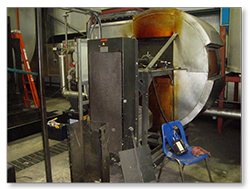
PT Engineer using VIBXPERT IIVIBXPERT II and accelerometers mounted on fan’s bearings
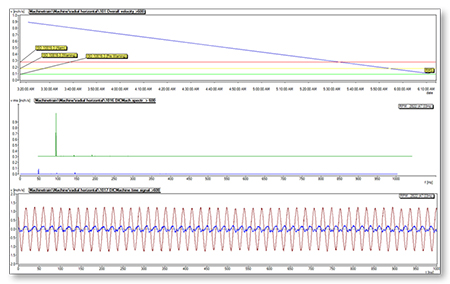
Accumulation of dust and dirt on all rotor blades leads to a 1x vibration peak in the velocity spectrum. The sine waveform and phase analysis confirmed the results. A static unbalance was the reason for the increased vibration.
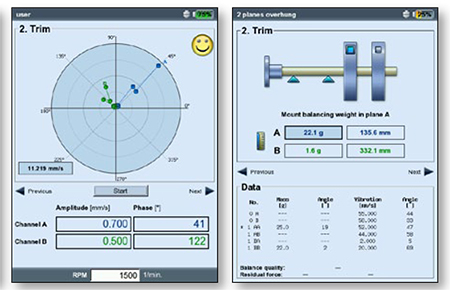
The balancing procedure was successfully performed on-site during the next shutdown phase of the plant. VIBXPERT II and OMNITREND® software were used for the balancing runs. The static unbalance requires only a one-plane balancing procedure which was ideal for those fans. The accelerometers were attached to the non-drive end (NDE) bearing in the horizontal direction. VIBXPERT offers a “second plane control feature” where the second accelerometer controls any negative influence on the NDE bearing during trim runs. This ensures that the vibration on both bearings will be equally reduced and balanced. The target quality grade of 6.3 according to DIN ISO 1940 was easily reached.
The plant went back online a few days later and the customer was extremely satisfied with the result of this service, he later stated:
“In the last 6 years, I have never seen those fans run so smooth.”
Screenshots of VIBXPERT II handheld device
“Before and After” Results Screenshot using OMNITREND SW
Special thanks to PRUEFTECHNIK Canada for sharing this success story with us.
A strobe lights is an inexpensive tool that every vibration analyst should have. Typically, strobes are used to determine the operational speed of equipment. However, a strobe can be used for many other troubleshooting activities. For example, coupling inspections can be completed to identify wear or other issues. The strobe can be set to a specific frequency to identify the source of an issue revealed by vibration analysis. Many other troubleshooting tasks can be easily completed using a strobe. Do not overlook the value this device offers.
The safety strap which is included with the analyzer should be checked for condition prior to each use. Most safety straps use Velcro and the Velcro is there for your safety. The strap is designed to separate to prevent injury should your cables become tangled in the rotating shaft or some other moving part of the machine.
Replace the straps if the Velcro becomes dirty or no longer holds. Never glue, bolt, staple, or otherwise permanently affix a strap to the analyzer, because this could prevent the strap from functioning correctly and result in serious injury to you or a coworker.
An accelerometer is often used with a magnet to couple the sensor to the machine. The coupling between the magnet and machine is critical to ensure quality vibration data is acquired.
Placing the magnet onto the machine can create an impact that can shock the sensor for several seconds. Collecting data during this time can skew the results. The magnet should be rolled onto the machine to minimize the impact. Once the magnet is “Rolled” onto the machine the analyst should feel the magnet to see if it has a good contact or is loose. If the magnet feels loose try rotating the magnet either clockwise or counterclockwise to obtain a more secure fit. Additionally, move the top of the sensor to check for a secure fit as well.
These steps will help you check for sensor placement issues that could impact the quality of data collected. By making these checks you have also allowed any impact signals from attaching the magnet to the machine to decay out of the signal.
Is your vibration analysis program or other Condition Monitoring technology simply predicting failures or also identifying the causes of the failures?
Vibration analysis is a very useful tool for identifying failure modes in equipment. Bearing failures, unbalance, misalignment, belt issues, and many other problems can be easily identified with vibration analysis. However, the value of vibration analysis goes well beyond just simply identifying what equipment is about to fail. Stopping at this level will ensure that the same failure will most likely occur again in the future and be identified again in the future by your vibration analysis program or other CM technology.
A good vibration analysis data collector and software will have tools to help you identify what is causing the bearings to fail, misalignment to occur, etc in your equipment. Use this additional functionality to identify the root causes of the equipment failures that your routine vibration analysis efforts uncover. This will allow you to eliminate the things that are causing the failures in your equipment. This means that your facility will replace fewer bearings, do fewer alignments, etc. on your equipment. This will save maintenance dollars and increase the overall reliability of your equipment.
Most facilities have multiple Condition Monitoring technologies like vibration analysis, oil analysis, thermography, etc. However, most plants do not use these CM technologies to jointly identify, confirm and report equipment issues. Do not underestimate the value of using the results generated from these technologies together.
Have you ever had a Maintenance Manager or other manager in your facility not truly understand a CM technology and discount the results? Management may make comments like “that magical black box cannot identify this type of problem or cannot give an accurate sense of severity“. The Analyst or Reliability Engineer knows the truth and the value of the CM technology. Consider presenting the results from multiple CM technologies together in the same report. For example, what if you went to your management with information from both oil analysis and vibration analysis? You could demonstrate that what one CM technology had identified the second technology had confirmed. This increases the credibility of the CM technologies and your reliability efforts. It becomes much more difficult for management to discount a technology when the findings have been confirmed by another CM technology.
iPURCHASE, A supplement from IMPO MAGAZINE • March 2012
Companies are attempting to operate leaner and more efficiently every day, with predictive maintenance still serving as a driving force. With a variety of tools on the market, there is something for every operation, large or small.
There is so much technology available to manufacturers and distributors, it’s hard to know where to start looking, especially when it comes to industrial maintenance equipment.
Getting Started
If you’ve thought about starting up a predictive maintenance program in the past, but have shied away because of the details involved, or if you currently have a program in place and just aren’t seeing the results that you would like to see, you are not alone – this is a complex topic with constantly evolving technological solutions. And from a distributor standpoint, possessing a purchasing and sales team that truly understands the functionality and value these tools can bring to the customer is a great way to stand out from the pack. Two individuals in the predictive maintenance industry who deal specifically with vibration analysis were willing to share their scoop on the issues that they found most critical to understanding the significance of this technology.
“Predictive maintenance technologies can be applied to almost any equipment or system that has rotating, electrical or lubricated components,” notes Trent Phillips, the Condition Monitoring Manager for Florida-based LUDECA, Inc. “This includes motors, pumps, fans, gearboxes, turbines, generators, compressors, milling machines and many more. Some of the common equipment faults detected with vibration analysis are bearing defects, lubrication issues, misalignment, unbalance, gear defects, electrical problems, belt issues, resonance, looseness, foundation problems, and many more.” It looks like everybody needs predictive maintenance equipment.
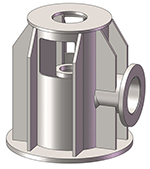
Smith Pump Company recently was called to a pump station to solve a problem with high vibration on three 350HP vertical turbine pumps. The pump station was fairly new and had only been in operation for a year or two. Two of the three pumps were operated on a variable frequency drive (VFD). The first step we performed in the field was a bump test. A bump test measures the unit’s natural frequency and is very important on a vertical turbine. The unit, mainly the vertical motor, will vibrate the most when it runs at its natural frequency. For example, if you measure the unit’s natural frequency to be 1800 CPM and the pump’s speed is 1800 rpm, you will have a high vibration. To save time, we will only present the data for Pump #2. The bump test for Pump #2 measured in line with the discharge was 1500 CPM. Pump #2 operates on a VFD and has a full speed of 1800 rpm. The 1500 CPM corresponds to running the pump at 50 HZ. The owner of the pump station wanted to operate the pumps between 50 to 60 HZ. After performing the bump test, we ran the pumps and measured vibration with the VIBXPERT® analyzer. On pump #2 at 50 HZ, we measured 0.47 in/sec RMS at the top of the motor. To compare, the Hydraulic Institute allows 0.17 in/sec RMS for a vertical turbine pump of this size. We knew high vibration was caused by the natural frequency of the unit based on the bump test data. On vertical turbine pumps, you can move the natural frequency up and down by making modifications to the discharge head. These particular discharge heads were built very stiff with a total of eight 1” thick stiffeners on the outside of the head body and four 3/4” thick stiffeners on the inside of the head body.
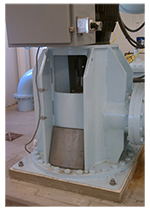
Existing Discharge Head
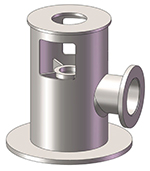
Solidworks Model of Existing
Smith Pump modeled the discharge head in Solidworks. Since the measured natural frequency was 1500 CPM, and the pump operating range was 1500 to 1800 RPM, we wanted to lower the natural frequency below 1500 CPM. We knew by removing stiffeners from the discharge head we would lower the unit’s natural frequency. We removed stiffeners and ran a finite element analysis to determine how much we would lower the natural frequency. Our model study showed that by removing all the external stiffeners and half of all the internal stiffeners we would lower the natural frequency by 30%. Pump #2 was removed and its discharge head was modified by removing stiffeners.
Solidworks Proposed Model
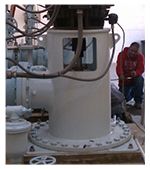
Discharge Head Installed Stiffeners Removed
Pump #2 was put back into service with its modified discharge head and vibration testing was performed. The new bump test data gave a measurement of 86 CPM in line with discharge. The vibration measured at 50 HZ at the top of the motor was 0.05 in/sec RMS. The vibration dropped from 0.47 to 0.05 in/sec RMS.
In conclusion, determining a unit’s natural frequency is very important when designing a vertical turbine pump. Every fabricated steel discharge head that Smith Pump makes is modeled in Solidworks and goes through a finite element analysis to make sure the unit’s natural frequency (mainly discharge head and vertical motor) is 25% away from any running speeds. In this example, the discharge head (built by others) was too stiff and had a natural frequency at the pump operating speed causing high vibration. Since Pump #2 was so successful, we are currently modifying Pumps #1 and #3 the same way. Common sense tells us that the stiffer and stronger the discharge head the better, but this case study clearly shows us that is not the case!
Special thanks to our customer Josh Jurgensen, service engineer at Smith Pump Company for sharing this case study with us!
Have you desired to improve your analysis skills? Maybe you’d like to become more proficient with recognizing and interpreting the nuances of phase data? The best way to do this is by adding it to your daily routine, in your routes. By viewing phase data every day, you’ll soon become comfortable with it and it won’t be some of the “other stuff” you’re not used to looking at.
Simply add a cross-channel phase measurement to each point on a machine. Maybe just try it on one machine that has been a bad actor in the past. At first, you may want to “practice” analyzing with phase. Get out the old training material that has been gathering dust since you passed (hopefully) your analyst-level certification. See what it says about phase and its interpretation. LUDECA has some free help in the form of articles and technotes.
If necessary, further training is available with online sessions now added to the standard classroom offerings by many training concerns.
To get started with taking the cross-channel phase (CCP) with your routine route data, remember to take along an additional cable and accelerometer. The first time, you will need a marker to mark the place to put your reference accelerometer. When you get to the machine, mark the spot on the machine where you want to place your reference accelerometer. It will need to be meticulously placed in the same spot each time you collect data. Even though technically channel ‘A’ is the reference, I suggest you use channel ‘B’ as your reference when taking CCP in a route. In this way, you can move the ‘A’ accelerometer from point to point, just as you would when normally while collecting your route data, and the CCP will be a simple addition to your point data.
This will reverse the “direction” of your phase, so what would have been 270°, will now be 90°. Since both 270° and 90° have a “delta phase” of 90° from zero, the delta remains the same.
Place your channel ‘B’ accelerometer on the spot you marked, and begin taking data normally. When it’s time to take the CCP data, you will be prompted to tell the VIBXPERT® what the speed of the machine is. The speed you enter must be quite accurate as this can affect the quality of your CCP data.
When you collect the data, pay attention to the “Coherence” number at the bottom left of your VIBXPERT screen.
This number quantifies the reliability of the relationship between the vibrations sensed by your two accelerometers. It should be at, or very near 1. A ‘1’ signifies a very valid relationship between the vibrations sensed by the two accelerometers. The further away from 1, the less reliable your data will be.
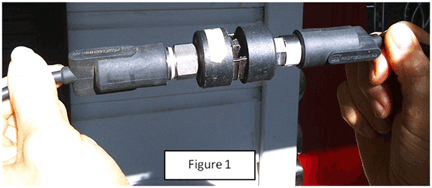
Now, when you analyze the data, you will notice that each CCP capture has two distinct components, a “delta phase” and channel A & B amplitudes. The amplitudes are of course the amplitude sensed on each accelerometer at the chosen frequency. The delta phase is the phase difference between the two accelerometers at the chosen frequency. NOTE: It is very important, when analyzing phase data, to remember to allow for accelerometer orientation! The two accelerometers pictured in Figure 1 are “oriented” in opposite directions. They will sense exactly the same vibrations but with a 180° phase difference. To account for this orientation difference, one must either add or subtract 180 from the phase quantity.
As you compare the delta phase from point to point, remember to take into account the accelerometer orientation (see NOTE!)
Now you have “how”, or “in what direction at what time” the machine is vibrating. Couple this with your “how much the machine is vibrating” data that you were getting before, and certain defects (like misalignment) should be able to be diagnosed with a much greater confidence level.
Remember too that if there is no amplitude, there is no problem. For example, ‘In-phase’ vibration at horizontal radial at both ends of a machine coupled with in-phase vibration at vertical radial at both ends of the same machine, with the delta phase from vertical to horizontal of about 90°, is a very, very strong indication of static unbalance. But if the amplitude is well below the point at which any harm is done… no problem.
Enjoy analyzing with one more powerful tool in your toolbox in 2012!
In today’s industry, predictive maintenance plays a big role in keeping machinery operating in peak condition.
Many maintenance departments strive to have a first-class predictive maintenance program; they do this by collecting data on a continuous basis through routes with handheld data collectors to evaluate the health of the machines that are needed to keep their plants producing at full capacity.
The data collection process, a key element in this task, can easily be flawed if we are not careful with various aspects of the placement of the sensors used to collect the valuable data. Consistency in the placement of the sensor on the equipment being monitored is key. Otherwise, the accuracy and reliability of the data collected can be compromised. Is the sensor being positioned in exactly the same place, at the same angle, and pressed with the same pressure each time data is collected at a given point? As machines age or are refurbished, they may be repainted; over time, several coats of this protective paint may be added. This can interfere with the positioning of the magnetic base of the sensor and the quality of the data collected.
Solution: A Stainless Steel disc can be permanently mounted on the equipment either by drilling and tapping the bearing housing or by using a special adhesive. This will allow for a firm location to mount the magnetic base of the sensor on the machines and will ensure consistency in the placement and location of the sensor. With a capable data collector such as the VIBXPERT® and a smart sensor such as the VIBCODE®, the analyst in charge of a predictive maintenance program can measure the data consistently every time, and on the first attempt. The VIBCODE smart sensor interlocks into a permanently mounted stud, guaranteeing consistent measurement placement, angle, and pressure every time. The measurement stud is encoded with the location number and the required measurement(s) type(s), making the data collection process fully automatic. Besides guaranteeing consistency in sensor placement, VIBCODE greatly streamlines the data collection process —saving time.
A condition monitoring analyst encounters many challenges. One of the primary ones is to determine when to report a defect finding. Should it be reported now or should reporting wait until the severity of the defect increases? How near is the problem that has been found to actual failure? Each of these questions is difficult to answer.
A good analyst can use the condition monitoring data that has been collected to determine the severity of the problem found. However, it is impossible to determine the time of day the identified component will actually fail.
What happens if the replacement component (bearing, etc.) requires a very long lead time to obtain? What happens if a crane has to be scheduled to remove the equipment for repair? What happens if contractors have to be scheduled to support the repair effort? What if an outage is scheduled soon and the analyst waits until afterward to report the problem?
The vibration analyst is expected to use his or her tools to gather the right vibration data to determine the practical health of process equipment. To distill a systematic workflow of this task, it can more easily be understood in the terms of an “input-output” process. The inputs are data taken from the equipment, the output is actionable information which itself is a necessary input to an efficient maintenance process.
The inputs can be boiled down to 4 individual bits:
A. Frequency data
B. Amplitude data
C. Phase data
D. Other physical observation/information
These inputs are fed into a data analysis process which is expected to yield information dependable enough to help guide the actions of those caring for the equipment. Unfortunately, the old computer adage applies big time to the vibration analysis process: “garbage in, garbage out!”. If the input data (A, B, C, and D referenced above) are not of good quality (garbage), then the analyst cannot output quality actionable information as input for the maintenance process within a facility. The results of the vibration program and analyst are called into question.
Not only does the reputation of the entire vibration program suffer, but the facility will not benefit from the value that is offered by a vibration analysis program. It is the challenge of the vibration analyst to make sure that proper data is collected and correct analysis is completed. This will allow for valuable information to be supplied to the maintenance process within a facility. Predictive technologies such as vibration analysis should be one of the core ingredients for the overall maintenance process (planning and scheduling, parts inventory, etc) at your facility.
The only way to make this happen is to avoid the “garbage in, garbage out” effect and follow a “quality in, quality out” process with your data collection and analysis activities.

 An air conditioning and heating systems manufacturer in Texas is challenged to continue providing the industry with leading products, while meeting high-reliability standards, maintaining affordable prices, and meeting increasing worldwide demand for the products they manufacture. All of this must be done in a way that provides the expected financial return for stakeholders. An internal evaluation was completed to determine how to achieve and continually meet these goals. It was determined that the negative consequences of unplanned downtime, high production costs, inability to increase production capacity and product quality issues were putting these goals at risk. The goal of the facility is to maintain equipment uptime and availability at greater than 90%.