
Maintenance and reliability professionals track many key performance indicators (KPI’s) to measure the success of their efforts. These indicators can be overwhelming but are necessary to confirm the proper direction and achievement of desired results.
It is important that your CMMS (computerized maintenance management system) has the ability to categorize work orders. Condition monitoring work orders should be categorized by main types and by sub-types (vibration, lubrication, thermography, ultrasonic, electrical, etc.) upon creation within the CMMS.
Your CM and Reliability team should actively track condition monitoring work orders by total created, their type (vibration, lubrication, etc.), status (in process, scheduled, completed, etc.), the average length of time to completion, rejection results, and so on.
These indicators will allow you to ensure that a healthy amount of CM work is available and that this work is given priority, being properly planned, scheduled, and executed. It does no good to detect and report a conditional change in equipment only to have it ignored, not properly repaired, and then result in a functional failure.
Additionally, technology alarm status can be compared to open corrective work orders in your CMMS. For example, a corrective work order should exist addressing each severe alarm condition (red) reported by a CM technology. If a corresponding work order has not been created, then you should ask “Why”? Is it due to a bad technology alarm? Did the CM analyst miss something or fail to report the condition or repair? Or did the planner or scheduler simply overlook or ignore it?
Monitoring these indicators can help ensure that your CM program is providing continual results that will move your reliability efforts forward.
What indicators do you track to determine success with condition monitoring efforts within your company?
by Trent Phillips CRL CMRP - Novelis
It’s a cruel reality but in a business-minded world, companies are concerned with only one topic: PROFIT. And there are two ways to go about maximizing profits: Either increase the number of sales or decrease the total costs.
One aspect of business that has a significant impact on a company’s profits is expenses incurred due to equipment failure. Yet the maintenance cost for down equipment is just a piece of the pie that comprises the total costs and often the expense of parts and labor to repair the machine can be one of the smaller costs. Other more significant costs include lost production, contractual penalties, consequential damages, and liability for injury, all of which can exceed the cost of the repair itself. One way to decrease a company’s machinery failure rate and thereby increase profits is through proper alignment. Good alignment allows machines to run more efficiently, consuming less power and increasing output. Power loss (or power savings) is only a ‘small piece of the saving pie’. However, it will be always significant. For instance, alone a 30 kilowatt per hour reduction in power consumption on a large compressor train at $0.06 per kWh can save you up to $15,768.00 in electricity per year.
Precision alignment pays by reducing operating costs, and downtime costs, improving machine reliability, and increasing uptime and profits.
by Tim Rogers CRL
- Right safety procedures before you balance.
- Right machines to balance.
- Right balancing procedure.
- Right balancing tool.
- Right balancing tolerances ISO or API.
- Right data collection
- Right weights.
- Right weights locations.
- Right corrections.
- Right balancing report.
Download [Infographic] 5-Step Balancing Procedure
by Ana Maria Delgado, CRL
WIP is an acronym for “Work In Progress”. An example of WIP is when the widget must progress through different production processes that change fit form or function before reaching a stage of final completion and readiness for shipment to the end-user. Work management is required to ensure the widget moves through these stages at the proper time and under the correct conditions. Most production facilities have some type of WIP that is followed.
Maintenance activities must follow a WIP process to ensure success as well. As the graphic below illustrates maintenance work should start out as a maintenance request and progress through the critical stages shown below before competition. Each stage must be closely monitored to ensure that bottlenecks do not exist or stages are bypassed as the work is started and executed.
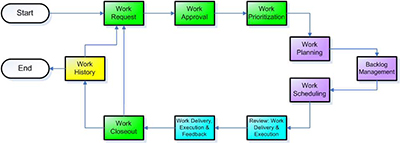
The goal is to ensure that the Right Work is done at the Right Time and in the Right Way. Feedback and work history make the final steps in the execution process to help ensure any improvements are known and implemented.
Do you WIP your maintenance process to ensure proper execution of work?
by Trent Phillips CRL CMRP - Novelis
Management and co-workers do not always understand why Condition Monitoring (CM) Analysts spend so much time in an office looking at a computer screen. What are they doing? What does that have to do with condition monitoring activities, equipment repairs, and reliability efforts? Why are they not in the field collecting data?
Why are they not working on equipment maintenance? Unfortunately, these misconceptions often result in a perception that CM Analysts are not doing their job and they are pulled back into routine maintenance activities or assigned other work tasks.
The reality is that four critical steps must be consistently completed by a CM Analyst for the program to be successful. First, valid data must be collected with the CM technology at proper measurement intervals. Second, the collected data must be properly analyzed. Third, the findings must be promptly reported in a meaningful way to those responsible for planning, scheduling, and completing the CM results. Fourth, the database(s), measurement methods, and equipment information must be constantly updated. Additionally, routine research is required to ensure that proper measurement and analytical techniques are being applied, needed information is available, etc.
Successful completion of the critical steps outlined above requires time in an office environment using a computer. Not allowing your analyst(s) this necessary time will ensure failure and result in needless reliability issues. An old rule of thumb is that for every hour a CM analyst spends in the field it will require an hour in the office processing that data, reporting the findings, etc., as explained above. The time in the office can vary depending upon how well the CM database is set up with proper alarms and measurement criteria. In addition, the analysis software, CMMS software, and other resources can be a critical factor in determining how much office time is required.
The point is that an analyst requires office time to properly process, report, and maintain his CM efforts.
Otherwise, the CM program is certain to fail. Provide time for the analyst(s) to do the job being asked of them or don’t be surprised when these efforts fail.
by Trent Phillips CRL CMRP - Novelis
As Published by BIC Magazine December 2015 issue
A world-class reliability program is not achieved overnight, yet you must start somewhere. Your first step is to vest your entire human capital in its success. Reliability is a culture, not a goal, and it flows from the top down.
Therefore, executive sponsorship with integrity and enforcement is a must. Obtain buy-in to the culture of reliability from everybody in your organization, or the effort is doomed to fail. Start with this realization, and your reliability effort will ultimately succeed, and you and your stakeholders will reap its rewards.
The reliability workflow must be well organized and underpinned by a Computerized Maintenance Management System (CMMS). Let’s look at how it works in a world-class program.
Ultrasound analysis detects a bearing fault in a critical motor early in the P-F curve. The analyst enters this data in the CMMS and trends it. The analyst decides to request a work order with recommendations. This is Stage 1 in the work order process.
The work order is now reviewed by both maintenance and operations, thereby ensuring buy-in from operations as well. This is Stage 2. This review process ensures only truly needed or valuable work is approved. Also, older open work orders can be combined with this one to further streamline planned activity on the asset. For instance, an earlier work order was created to align the machine, but the work was never carried out, resulting in the bearing damage the ultrasound analyst has now detected. The review process would catch the older open order and add it to the present order. This would prevent the millwright from going out to align the machine tomorrow only to have a repair technician go out the following week and repair the motor but do no alignment on it. This review process tries to eliminate inefficiency, duplication, and detrimental work sequences.
Stage 3 assigns the work order to the maintenance planner for action. Only approved and truly necessary work enters the planner’s backlog. The planner ensures work is properly prioritized. Two things are needed: The criticality ranking of the asset (ascertained from systems’ criticality analysis) and its operational criticality. Both of these factors can be multiplied together to create a more accurate prioritization of the workflow. The planner creates a new work plan if needed and should consult with maintenance supervisors and technicians; valuable insights may be gained into what parts, tools, and equipment should be specified in the work plan. Next, the planner orders the maintenance, repair and operating materials (MRO) spares, and tooling required to complete the job and verifies the parts are available and kitted (best practice). The planner should not concern himself with scheduling.
Now on to Stage 4: assignment to the scheduler. The scheduler allocates the HR and necessary time to accomplish the task, with a cushion for unforeseen complications. He too should consult with the maintenance supervisor and technicians to obtain cooperation and buy-in to the schedule. Coordination with operations is crucial. Operations “owns” the equipment and must sign off on the schedule to bring the asset down.
Stage 5 assigns the order to the appropriate maintenance and electrical supervisors, who in turn assign specific tasks in the work plan to their respective repair technicians, electricians, and millwrights, and verify MRO spares has delivered the parts kit to the proper location.
Now the work order enters Stage 6: the work execution phase. Once the technicians have completed the work, they report to their supervisors, who return the asset to active duty status in the system. Operations is notified the asset is ready for service, and MRO spares is notified of any unused parts and supplies that should be returned and reintegrated into the MRO spares inventory. Technicians and supervisors should feed their observations and data into the CMMS system.
Stage 7 sees the ultrasound analyst performing follow-up data collection on the asset to ensure all is well. The work now goes back to the planner to be formally closed. This ensures all important data has been accumulated and distributed within the system, enabling key performance indicators to be updated.
As good data accumulates, reliability engineering will use it to improve the entire reliability and maintenance process, discover frequent failure patterns, identify training needs, drive out defects, streamline production and help to improve the design process. As the plant becomes more efficient and productive, greater resources can be allocated to defect elimination and strengthening condition-based maintenance technologies, further impelling the transition to a proactive, reliability-centered culture. Reliability is a never-ending journey of continuous improvement.
by Alan Luedeking CRL CMRP
Guest post by Jeff Shiver, Founder of People and Processes, Inc.
As a maintenance planning and scheduling professional, I am often asked how to schedule maintenance activities when production is 24/7 or 24/6. An important question is whether the 24/7 operation is driven in part by a lack of reliability or if the organization is proactive and actually capacity constrained. In either case, the challenge is finding windows for work with the equipment stopped or shut down.
- Failure to identify smaller windows for work
- Give work to operators
- Lack of partnership between the operations and maintenance group
- Get the work done right
- Make resources available
- The right focus on preventive maintenance (PM)
- Identify failure
- Act, don’t react
- Don’t defer PM tasks
- Failure to take advantage of unplanned downtime for proactive work
- Manage the backlog
- Lack of effective coordination between the crafts
For more details, please read the full article.
by Yolanda Lopez
Have you ever considered what your company’s definition of “maintenance” maybe?
Unfortunately, within many organizations “maintenance” is simply synonymous with “fix-it”. Maintenance is derived from the word “maintain” and that concept is critical for equipment reliability. Basically, your goal should be to maintain your equipment to some standard and functional ability. When equipment is allowed to reach a point of breakdown, then we have actually failed to maintain it.
How do we maintain our equipment to standards for performance, safety, quality, etc.? Here are four examples:
- First is design.
- Second: proper installation.
- Third: good operation – Improper operations can result in breakdowns and the inability of a machine to meet the defined standards.
- Fourth: precision maintenance skills, condition monitoring, planning & scheduling, and execution of the foregoing are required to maintain equipment and ensure it can meet functional requirements upon demand.
Always remember your maintenance department cannot overcome poor design, improper installation, incorrect operation of the equipment, and improper maintenance execution (poor craft skills, bad planning and scheduling, and so on). These things will result in repeated repairs (“fix-it”) and extra costs to meet the desired standards (operation, safety, quality, etc.) Properly maintaining equipment requires the involvement of many individuals and groups within your company.
Perhaps some discussion about the definition of “maintenance” may create opportunities for improvement within your company.
Visit our Knowledge Center for resources and tools to help you succeed when implementing and using our maintenance technologies! Watch our video tutorials, download infographics, plus explore other helpful information to reduce equipment failures and downtime.
by Trent Phillips CRL CMRP - Novelis
I recently participated in an alignment done on a boat. The alignment was between a diesel engine and V-transmission connected by a cardan shaft.
The Challenges:
- The offset between the gearbox and motor was a little over 1 inch.
- Aligning the engine to the transmission without removing the cardan shaft.
- Alignment is difficult because it has to be done while the boat is in the water, which means conditions can vary as the job is being performed.
The Solution:
- Use a ROTALIGN® ULTRA laser alignment system with compact magnetic brackets, which allow mounting the components even in very tight spaces. See Figure 1.
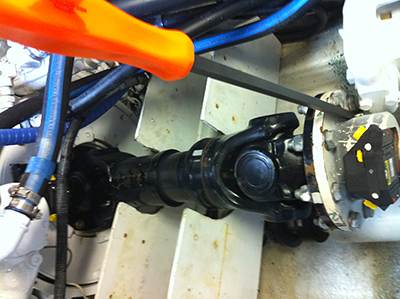
Using the Multi-point measurement mode allows measuring accurately even with the waves affecting the stability of the boat. This measure mode allows us to increase the number of points collected at each arbitrary measurement position. Multi-point also lets us use the “InfiniRange” feature which allows extending the measurement range of the detector during a set of readings, thus making it very easy to cope with the large misalignment across the cardan shaft.
by Carlos Bienes CRL
Have you ever been asked “How much longer will it run” or “Can we make our production schedule” or other ‘crystal ball’ type questions? These types of questions can be very difficult or virtually impossible to answer. They often place a reliability professional in a difficult position.
Some future indicators are (or should be) available to the organization that will help you answer the above questions when asked. Four of those indicators are:
- Preventive Maintenance (PM) Completion Rate
Low PM completion rates directly correlate to increased future equipment maintenance work. High PM completion rates mean that needed equipment maintenance is being completed and future maintenance issues will be avoided. - Ready to Work Backlog
This is an indicator of preparedness and efficiency to complete maintenance work. - Outage Schedule Compliance
This is a very important metric to track and is an indicator of future maintenance work. A lack of adherence to outage schedules creates deferred equipment maintenance. This results in increased risks and the likelihood that equipment performance will decrease at a future time, leading to lower capacity, increased downtime, and greater expenses. - Equipment Asset Health Reporting
Proper utilization of condition monitoring technologies like vibration analysis, IR thermography, lubrication analysis, ultrasound, and others are a proactive strategy to ensure that hidden failures become known and corrected before they result in equipment downtime or other unwanted consequences. Tracking these indicators together can provide insights into future asset health. A lot of “red” assets from these technologies will result in future unwanted equipment maintenance and unwanted downtime if corrective action is not taken. Additionally, this can be used to help prioritize equipment maintenance efforts if a good critical equipment ranking system is in place.
by Trent Phillips CRL CMRP - Novelis
Everyone within your organization should be passionate about improving and maintaining equipment reliability.
However, some groups have more or less to gain from that.
Unfortunately, skipping or moving planned work outages, rushing equipment repairs, not allowing proper maintenance activities to occur, and other disruptions are commonplace within many organizations. These are often influenced or controlled by the Operations Department.
The Operations Department within your organization should be extremely passionate and focused on ensuring that proper maintenance and reliability efforts are implemented and maintained. Why? This group has a tremendous amount to lose or gain from asset performance. This group should be an active part of all reliability efforts. The Operations Department should insist on activities like:
- Preventive Maintenance (PM) Optimization
- PM Compliance
- Precision Maintenance
- Root Cause Failure Analysis (RCA)
- Proper Planning and Scheduling (PS)
- Critical Spares Analysis
- Operator Care Activities
You must be a reliability evangelist and constantly provide education and awareness to help the Operations Department and others understand what they have to gain by promoting and insisting on reliability practices. This will help you lead your organization to improved and sustainable equipment reliability.
by Trent Phillips CRL CMRP - Novelis
- Right safety procedures before you align.
- Right machines to align.
- Right alignment procedure.
- Right alignment tool.
- Right alignment tolerances.
- Right alignment targets.
- Right soft analysis and correction.
- Right shims.
- Right moves.
- Right bolt tightening sequence.
- Right bolt torquing.
- Right alignment report.
by Ana Maria Delgado, CRL
Who owns equipment reliability in your plant? The answer may surprise you. It is commonly thought that equipment reliability is owned by the maintenance staff in a facility. Is this true? Let’s look at all of the owners of reliability in your plant:
Engineering is responsible for the design of (and often oversees) the installation of new equipment. Your maintenance team cannot overcome poor design and/or poor installation of equipment. They will be tasked to routinely fix the issues that result from improper engineering efforts.
Sales and Marketing have a certain amount of control over equipment reliability. They can affect maintenance schedules, operational schedules, etc.
Purchasing and the storeroom contribute to equipment reliability by ensuring that proper parts are available and kitted when maintenance work is scheduled. Cheap parts, no parts, wrong parts, no kitting, etc., all contribute to maintenance and reliability issues in your plant.
Proper planning and scheduling are critical for equipment reliability. Otherwise, efforts can be misdirected resulting in reactive efforts and reduced reliability.
Operations can do certain maintenance tasks (operator-driven reliability) that allow the maintenance team to focus on more complex tasks and efforts that improve reliability. Operations may not allow proper time to complete required maintenance tasks and drive equipment to the point of failure through poor operation and contribute to reduced equipment reliability.
Management must set the direction and reinforce the achievement of reliability goals. Otherwise, equipment reliability will never be sustainable.
Maintenance staff must ensure that the work is done correctly (within specifications), on time, and with the correct focus. Efforts should be placed on identifying the correct work through Condition Monitoring and proper PM activities. RCM, FMEA, and other activities should be utilized that identify and drive out failure means and truly improve equipment reliability.
So, who owns equipment reliability in your plant? The answer is: Everyone!
by Trent Phillips CRL CMRP - Novelis
Guest post by Fred Schenkelberg, Reliability Expert for FMS Reliability
A natural question to ask when something fails is “Why did it fail”?
The answer is not always obvious or easy to sort out. Some failures result from design errors, others are related to supply chain and assembly issues, and yet others occur because of seemingly random events (accidents, lightning strikes, etc.). As a reliability engineer, my concern is not simply accounting for end-of-life wear out; it is about meeting the operation’s reliability expectations. From design to failure analysis, by considering the range of possible sources I can identify and attend to the root causes that matter.
Consider a circuit board that has a small burn mark where a component exploded off the board. The customer failed to spot the missing part but noticed that certain features were no longer available. The box went dark and no longer powered up. It was dead, so the customer returned it. That is the failure mode – the loss of a feature or function. This is what the customer notices.
The engineer then has to investigate the root cause and identify the failure mechanism.
Failure Mechanisms and Root Cause
Failure mechanisms are the material or software code faults that lead to failure. They include thin insulation leading to dialectic breakdown, contamination leading to corrosion, or faulty code leading to an over-voltage command. Becoming aware of a product failure and starting to determine why it failed is an exploratory process.
The clues to when the failure occurs may help frame the initial investigation.
To answer the “Why did it fail?” question in a useful manner we need to determine the sequence of events that led to the failure. Root cause analysis is a process to determine this chain of events. The cause may be faulty material or assembly, damage, or design error. It may also include poor decisions and human error. Generally, we look for the physical or chemical reason for the failure. However, we should also explore the design, assembly, supply chain, and customer-related processes to ascertain where an error or weakness in the process could have contributed to the failure.
The idea behind seeking out root causes and determining failure mechanisms is to mitigate issues with problematic elements of the product whose failure would lead to product failure.
Types of Failures and Timing
Products fail for many reasons via many mechanisms. Most products have literally hundreds of ways in which they can fail. It is really a race between different mechanisms all vying to cause the failure. Eventually, everything will fail.
One of the first steps in sorting out the specific cause is determining when the product failed. How old was the product when it failed? Early life (e.g., when a product is just bought and installed) failures tend to cause more customer anguish than a product that has provided a long life of useful service. In general, we often talk about three periods of failure:
• early life failures
• random failures
• wear-out failures
The three periods are often depicted with a curve-shaped like a bathtub. The bathtub curve is the aggregate of many potential failures. Some tend to occur early, whereas some occur later. Each individual product has many possible ways in which it can fail and the most likely failure mechanisms may change over time as the product use and conditions change. Keep in mind that the curve is a fiction to explain a hypothetical profile of possibilities of failure over time for a single item.
Each period of failure also suggests a set of possible causes. Although this set is not always accurate, it provides a good starting place when looking for the root cause.
by Yolanda Lopez
When there is a lack of repeatability, or unexpected results are obtained during laser shaft alignment, a simple functionality test can be performed on the alignment tool’s heads to determine if they’re working properly. This can be achieved on a laser-and-sensor system, such as the ROTALIGN® ULTRA IS, or a transducer-and-prism system, such as the SHAFTALIGN® OS3. If the system passes the functionality test, it is most likely working properly. However, this test does not replace an official calibration check.
Perform the following procedure if there is doubt that your laser alignment tool’s heads are not working properly:
- Mount the heads on a piece of stiff pipe about six to ten inches apart. Do not use pipes that are smaller than two inches in diameter. Also, do not use solid shafting or bar-stock. The pipe does not have to be perfectly straight, but its surfaces should be smooth enough for the brackets to be mounted on.
- Enter the dimensions. Use the halfway point between the heads as the coupling center. Set the coupling diameter to ten inches. The remaining dimensions are irrelevant.
- It is ideal to mount the pipe on V-blocks, but this step can be performed with your hands as well: Center the laser beam on the dust cap. Remove the dust cap and take a set of readings while rotating the pipe 360 degrees. The coupling results should be zero or very close to it.
- Repeat this procedure at least four more times. Position the laser at different locations on the detector each time.
It’s as simple as that. If the coupling results are not consistently close to zero, the heads will likely need to be calibrated. We recommend that you have your heads calibrated every two years for optimal performance.
by Silvio Attanasio CRL
Traditionally, company profits have been maintained and increased through three primary means:
- Increase the price of goods and services sold.
- Increase the amount of goods and services sold.
- Reduce the costs of goods and services sold.
Options 1 and 2 can be very difficult or even impossible to implement in a competitive market. Therefore, option #3 may seem like the only viable option. Reductions in costs can be accomplished in many ways. Some are drastic attempts such as reducing product quality or the number of employees. It is almost impossible for companies to achieve true long-term profit gains in these ways because those gains are usually short-lived.
What can you do to help your company increase profits in the competitive world we live in, and provide greater stability in your job? Reduce the costs of goods and services produced (option #2) in a way that you or your facility may not have previously considered. You can do this by:
- Improving equipment reliability through implementing Condition Monitoring reliability practices (RCM, FMEA, RCFA, etc).
- Ensuring the correct maintenance activities are planned, scheduled, and completed on time.
- Ensuring that the correct spare parts inventory is available and kitted when the work is scheduled and executed.
- Ensuring that value-added PMs are created and completed on the equipment.
- Ensuring that reliability-based engineering is completed. Maintenance cannot overcome poor design and installation.
- Ensuring operational activities that support maintenance and reliability are followed. Maintenance and Operations should work as partners and not as competitors.
- Supporting those in your facility that are working toward these efforts.
- Make sure that the right work is being done on the right equipment. This requires prioritizing based on a thorough understanding of equipment criticality, understanding how and why your equipment can fail, what really needs to be done to keep it operational upon demand, etc.
All of the above efforts can help your facility reduce maintenance costs and the cost of goods and services produced. This could be the difference between being the leader in your market or watching your job, profit and company suffer.
by Trent Phillips CRL CMRP - Novelis
Facilities apply different management strategies with condition monitoring spare equipment. Some facilities do not routinely operate spare equipment until the primary equipment has failed. Others operate primary and spare equipment for equal amounts of time. It is critical that the management scheme ensures that both primary and spare equipment are equally operational upon demand.
As a condition monitoring analyst, it is vital that you periodically analyze the condition of both the primary and spare machines. This will most likely require asking an operator to start both machines so a conditional assessment can be made. Management should ensure that both machines are made available to the reliability team as may be required and verify that conditional assessments are routinely completed on both.
What happens if the primary equipment becomes non-operational for some reason and the spare equipment has an unknown defect that prevents its operation as well? The outcome is not usually positive! It is important to maintain the reliability of both primary and spare equipment. Collecting periodic condition monitoring data on both will help ensure availability when required.
by Trent Phillips CRL CMRP - Novelis
What seems like a “great idea” at the moment can often lead to regret and unwanted consequences later. This is true when it comes to equipment reliability and condition monitoring. What “great ideas” can a facility have today that can lead to unwanted reliability consequences later? Unfortunately, the choices are many!
Determination of condition monitoring intervals can be one of those “great ideas” that is regretted later.
It is possible to apply condition monitoring more often than is actually required to detect conditional changes in equipment, resulting in extra expenses being incurred. Conversely, it is possible to monitor equipment too infrequently for important conditional changes to be noticed on time and failures to occur. It can seem like a great idea to base condition monitoring frequencies upon arbitrary intervals, available manpower, or some standard sampling frequency (such as 30, 60, 90, or 180 days.) Each of these could prove to be an unfortunate decision taken on behalf of your reliability efforts. Make sure your condition monitoring frequencies are based upon the P-F interval. The equipment will usually let you know how often condition monitoring technologies should be applied and the P-F interval is a measurement of that. The appropriate sampling frequency can be determined with some effort and will ensure that you have no reliability regrets later.
Also read our blog called: “How do you set your condition monitoring intervals?“
by Trent Phillips CRL CMRP - Novelis
Are you running out of time to get your job done? Has your boss or supervisor saddled you with extra responsibilities? Are you not performing your PM tasks on time due to these extra responsibilities? If you answered yes to any of these, don’t feel alone in this ever-changing industry. We are all being asked to perform more with fewer tools and time. And yes, we must keep our equipment up and running!
I recently ran into this problem at a water treatment facility in the Caribbean. Besides the overwhelming amount of work demanded of the maintenance staff, they also have been unable to maintain their equipment. The plant was going longer than four months without any vibration analysis data collection on their machinery, resulting in preventable equipment failures with the consequently lost revenue and high cost of replacement. Due to the working environment, culture, and qualified staff shortage, the engineering group decided to invest in a wireless vibration monitoring system for their highly critical machinery.
After careful evaluation, they decided to install 8 VIBCONNECT RF sensors on four of their high-pressure pump sets. These pumps are critical in processing seawater into freshwater. Although the process of a desalination plant has several stages, the plant decided to first outfit these (four) 550 HP motors first before proceeding with the rest of the facility.
These critical pump motor sets cannot be ignored and have a good reliability program in place. Nor can they be ignored without end-user (consumer) dissatisfaction from no clean water availability due to equipment reliability issues. The plant made a small investment in the monitoring system in comparison to the cost of replacing the motors which failed.
As the maintenance manager stated:
If we could have prevented that failure and/or known that the asset was headed in that direction, we could have saved thousands of dollars. Not to mention the embarrassment of the bad press that comes from working in a government run institution…”
by Alex Nino CRL
Putting your machines away for future use may appear a simple operation; however, there are pitfalls that you should try to avoid. Storing machinery for certain lengths of time can bring about damage that could render that machine or some of its components inoperable to you when the time comes to use it. Here are some storage tips for success:
- First, select the driest environment available for storage. Surface corrosion is the enemy of every machine and thrives in moist air.
- Also, coat any and all exposed metal surfaces with a lubricant or oil mist to help prevent oxidation. Now that the machine and components are in storage, do not forget to maintain them. If your machine has moving parts, regular movement and rotation of its movable components will ensure that they run smoothly when brought into service.
by Oliver Gibbs CRL