

1. Introduction
A large number of condition monitoring (CM) programs fail—not because vibration monitoring is ineffective, but because managers and decision-makers lose confidence in the systems they install. Too often, these systems either fail to detect real faults or generate excessive false alarms.
The root cause is usually the same: organizations are misled by overpromises about limited solutions. Many believe that simply tracking overall vibration levels—such as:
- Acceleration Peak (Acc Peak)
- Acceleration RMS (Acc RMS)
- Overall Velocity RMS (per ISO standards)
is enough to guarantee the success of their investment. In practice, it is not. These indicators are quick to calculate, easy to trend, and provide a general overview of machine behavior. They are useful as first-level alarms, but on their own, they cannot ensure reliable fault detection.
After such disappointing trials, companies often become reluctant to reinvest, missing the opportunity to benefit from advanced monitoring.
This article is meant to clarify why simply “collecting vibration” is not the same as tracking every single change in dynamic behavior, and why relying only on overall levels inevitably leads to blind spots. By understanding these limitations, decision-makers can make informed choices about technologies that deliver real reliability and measurable return on investment.

2. The Mask Effect and Its Consequences
The mask effect occurs when one vibration source generates high amplitude and hides other components of the signal within the overall value. This can lead to a dangerous situation where the machine appears stable, while in reality new faults are developing.
Typical Scenarios of Masking:
- Dominant low-frequency phenomena: A strong unbalance at the shaft’s rotational frequency can dominate the overall RMS, masking misalignment, looseness, or early-stage bearing faults.
- High-frequency masking: When high-frequency components—such as gear mesh frequencies (GMF), bearing defect frequencies (BPFO/BPFI), or resonance excitations—are present, their high amplitude can increase the overall RMS tenfold. In such cases, the indicator becomes “blind” to changes in low or mid-frequency ranges.
- Resonance amplification: Structural resonances may generate very high peaks that saturate overall acceleration RMS, again hiding subtle changes in machine behavior.
As a result, overall levels cannot guarantee reliable fault separation or early detection, particularly when multiple phenomena coexist.
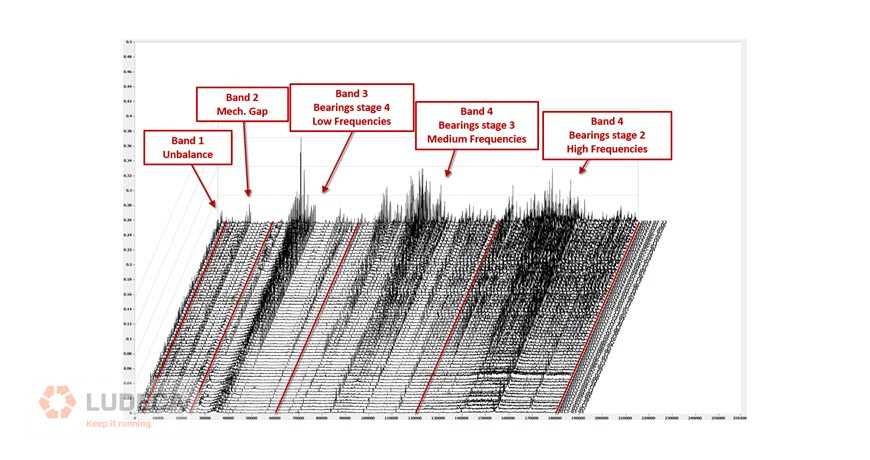
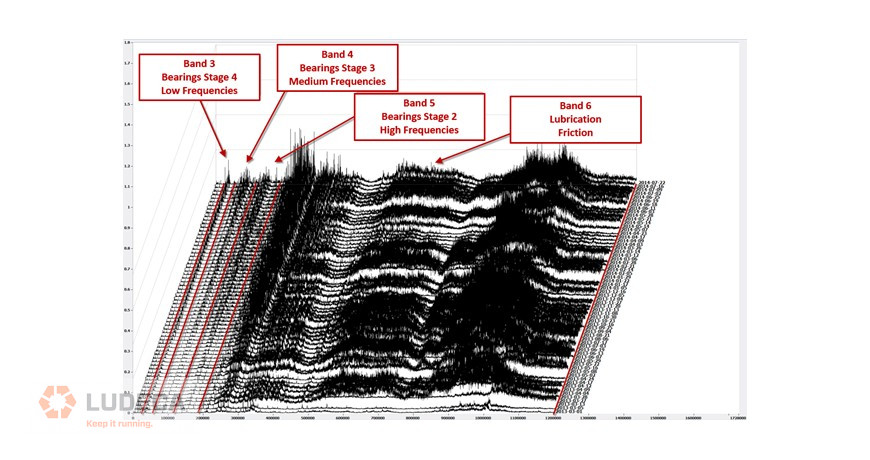
The following experimental data coming from real assets clearly demonstrates how standard overall vibration levels are not capable of detecting the change in the dynamic behavior of the monitored asset, not to mention detecting a health issue affecting the equipment.
While proper knowledge of the failure mechanism correlated with the right tools that VibWorks King is, it’s easier to notice that for the exact same machine and under the same timespan (6 years), the assets triggered danger levels 4 times, and was safely repaired during scheduled shutdowns.

3. The Right Solution: Power-in-Band Monitoring
Looking at overall RMS values is a bit like taking a photo with the wrong lens:
- If you only use a wide-angle lens, you capture the whole scene, but you miss the details—small cracks, fine textures, or subtle movements are invisible.
- Similarly, overall vibration levels (Acc Peak, Acc RMS, Velocity) give you the big picture of the machine, but they blur out the details of specific faults.
To truly understand what is happening inside the machine, you need the right focal length—the right “zoom” on the right part of the spectrum. This is exactly what power-in-band monitoring provides.
By splitting the vibration spectrum into a certain number of frequency bands, each “lens” focuses on a different fault mechanism:
- Unbalance Band – like zooming on the main subject (1× speed).
- Misalignment Band – the next focal range, catching distortions you’d miss with the naked eye.
- Mechanical Gaps Band – exposing looseness and coupling play hidden in the background.
- Bearings Low-Frequency Band – a macro lens for cracks and spalls appearing at low frequencies.
- Gear Mesh / Bearings High-Frequency Band – a telephoto lens capturing fine details of GMF and early bearing fatigue.
- Lubrication Band – a high-speed lens revealing subtle friction and micro-impacts invisible in a normal shot.
With this approach, each band acts like a dedicated lens for a specific phenomenon. No one effect can blur or hide another. You can “zoom in” on any change in dynamic behavior and capture a crisp picture of the machine’s condition.
4. Benefits of 6-Band Monitoring
By separating the vibration spectrum into these six bands, the monitoring system can:
- Isolate phenomena: Each physical defect mechanism is tracked independently (harmonics, shocks, friction, looseness, etc.).
- Eliminate masking: No single phenomenon can hide another—changes are visible even if overall RMS remains constant.
- Enable early detection: Slight variations in dynamic behavior are immediately identified.
- Improve reliability: Maintenance teams can intervene earlier, with clearer diagnostics and lower costs.
5. Conclusion
Overall vibration levels (Acc Peak, Acc RMS, Velocity ISO) are a convenient first step, but they are like a blurry snapshot—limited by the mask effect, especially when high-frequency components or resonances dominate.

The solution is power-in-bands monitoring, where each band acts as a dedicated lens focusing on a specific fault type. Instead of a single blurred picture, you get a complete professional photo album of the machine’s health: sharp, detailed, and unambiguous. This approach provides a full and reliable view of machine dynamics, eliminates blind spots, and enables confident, proactive maintenance decisions.
Thank you Betavib for sharing this valuable article with us!
4 Common Vibration Issues that are Easily Detected to Extend Equipment Reliability
Filed under:
Vibration Analysis by Diana Pereda