
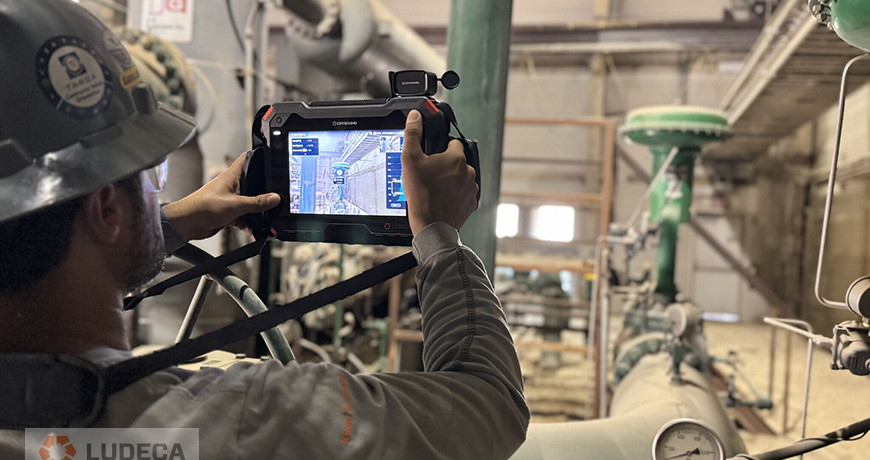
In today’s world, improving uptime, reducing energy losses, and enhancing safety are top priorities for maintenance and reliability teams across all industries. Acoustic imaging technology has emerged as a powerful tool in predictive maintenance, enabling professionals to quickly detect issues that are invisible to traditional inspection methods. By combining sound and visual data, this technology helps identify problems early and safely, before they lead to costly failures. Below are five key benefits of using acoustic imaging in industrial plants:
1. Versatility
One of the biggest advantages of acoustic imaging technology is its versatility. It can be used across a wide range of industrial maintenance applications, including compressed air systems, to conduct electrical inspections, and for mechanical equipment monitoring.
By providing a real-time acoustic heatmap, technicians can pinpoint the exact source of anomalies even in noisy environments. This reduces troubleshooting time and improves inspection accuracy. Unlike traditional methods, non-contact acoustic inspection allows for safer assessments from a distance, minimizing the technician’s exposure to hazardous conditions.
2. Energy Savings
Compressed air and gas leaks are among the most expensive and overlooked inefficiencies in industrial processes and facilities. Acoustic leak detection enables teams to quickly locate compressed air leaks, vacuum leaks, and gas leaks without shutting down operations.
When paired with a leak cost calculator in Ludeca’s CRY8128 Acoustic Imager, this technology becomes even more powerful. Maintenance teams can not only detect leaks but also quantify its financial impact in real time. This helps prioritize repairs based on ROI and supports energy-saving initiatives.
Early detection using ultrasonic leak detection can save thousands of dollars annually while reducing carbon emissions, making it a critical tool for energy efficiency and sustainability programs.
3. Safer Inspections
Electrical failures are a major cause of downtime and safety incidents. Acoustic imaging for electrical inspection can detect partial discharge (PD) phenomena such as corona, tracking, and arcing—often before they become visible or catastrophic.
Download our Electrical Faults: Signs and Signals with Airborne Ultrasound infographic for a basic guide to electrical faults detection using ultrasound technology.
Using a PRPD (Phase-Resolved Partial Discharge) plot, included in Ludeca’s CRY8128 Acoustic Imager, technicians can analyze discharge patterns and identify the type and severity of the fault. This enables more informed maintenance decisions and prevents unexpected equipment failure. Acoustic partial discharge detection offers faster scans, safer inspections, and improved fault finding.
4. Early Detection
Rotating equipment such as motors, pumps, and fans are critical assets in any plant. Acoustic imaging combined with vibration analysis helps identify mechanical faults such as bearing wear, misalignment, and imbalance. By integrating acoustic data into an FFT (Fast Fourier Transform) graph, the CRY8128 can display frequency patterns and help detect harmonic signatures associated with specific faults. Maintenance teams can then confirm these with vibration analysis to improve precise diagnostics and targeted repairs.
5. Efficiency with Accuracy
Steam systems are essential in many industrial processes, but faulty valves can lead to significant energy loss and safety risks. Acoustic imaging for steam traps and valve inspections allows technicians to quickly determine whether a valve is functioning properly.
When combined with an infrared (IR) camera, inspectors gain a more comprehensive view by correlating thermal imaging data with acoustic signals. This dual approach improves accuracy in identifying leaking, blocked, or failed steam traps. Improving the efficiency of steam system maintenance not only reduces energy waste but also enhances system reliability and operational safety.
Adopting acoustic imaging in industrial maintenance programs provides a significant advantage in today’s reliability-driven plant culture. From detecting compressed air leaks and electrical faults to analyzing mechanical failures and optimizing steam systems, this technology enables teams with fast comprehensive insights for better decision-making.
Filed under:
Ultrasound by Adam Stredel CRL