
A key feature of online machine condition monitoring systems is the automatic and immediate notification of system operators or service personnel. Technicians notified by email or SMS of increases in damage are able to react without delay. Today’s Internet is basically a global communications network at our finger-Technology tips. What, then, could be more obvious than taking advantage of the Internet for the communication requirements of condition monitoring systems. Just imagine: The monitoring system automatically sends you an eMail when condition deterioration sets in — along with all of the information you require for damage analysis. Thanks to the capability of today’s wireless communication networks, the service engineer responsible will be notified immediately, regardless of where in the world he may be at that moment. PRUEFTECHNIK online condition monitoring systems like the VIBROWEB® have already been equipped with these new functions and take advantage of the new web technology.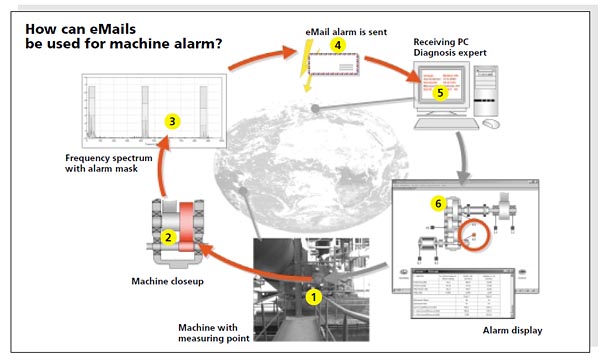 eMail – how does it work?
One of the most important Internet applications is eMail or Mail for short. The fact that Mail is not restricted to letters or texts, but can also be used to transmit files of any type is of particular significance. Unlike other Internet applications such as WWW, FTP, or Telnet, the Mail system does not require a direct connection between sender and receiver. Consequently, the receiver and sender computers do not have to be online at the same time. The Mail system is based on the concept of intermediate mail routers that receive and forward messages. Generally, the sender first directs the message to the Mail router of the Internet provider using suitable Mail software capable of the so-called SMTP protocol. SMTP stands for Simple Mail Transfer Protocol and defines the transmission of messages both by the message sender and between Mail routers. A message is passed from one Mail router to the next until it reaches the router responsible for the mailbox of the receiver. The first Mail router to accept the mail from the sender functions as the Mail gateway. The Mail router responsible for the receiver mailbox functions as the Mail Server. Once it has reached the Mail server mailbox, the message can be transported to the receiver’s target computer. For this to happen, the receiver must retrieve the Mail from the Mail server. This not only has the advantage that you can retrieve your Mail whenever you want, but you can also do so from any computer. Regardless of where you are, if you have Internet access and appropriate software you can access your mailbox at any time. The POP protocol is used for this purpose (Post Office Protocol). The user PC must have a suitable Mail program that registers with the Mail server by providing a user name and password and that queries whether there is any mail. The user PC is referred to as the Mail client. Any available Mails are listed and can be downloaded individually by the Mail client via POP.
SMS notification
Mail servers can provide services that supplement the automatic notification system by sending an SMS message to the receiver’s cell phone when an incoming Mail arrives.
eMails and condition monitoring
In condition monitoring practice, the vibration condition is evaluated using the overall vibration level or alarm masks for frequency-selective monitoring. If the PRUEFTECHNIK system detects that the limiting value has been exceeded, it can automatically send an eMail via the Internet or Intranet. The receiver obtains a clear text message containing the location, date, time, and cause of alarm. The information (time or frequency record) when the damage occurred is attached to the eMail. For additional analysis, the maintenance technician responsible logs into the Internet or Intranet and analyses the system at “local telephone rates” — without travel costs!
by Mickey Harp CRL
Reliable Plant, August 2010
Traditionally, plumbness measurements on a vertical hydro-turbine/generator shaft involved stringing a series of wires along the length of the shaft, attaching a weight to the end of the wires, and then measuring the space from the wire to the shaft using an electronic micrometer. Although this method was inexpensive and has been used for many years, it did require access to a long length of the shaft to achieve an accurate resolution. Also, measurements involve physically measuring the distance between the wire and the shaft at various elevations on the shaft, increasing the amount of time and personnel requirement for the measurement. Ludeca presents its experience with a laser-based system that replaces the time-consuming wire method. Measurements now can be performed in a fraction of the time it would otherwise take with the wire measurement method. Ludeca’s measurement system, known as the PERMAPLUMB, uses a self-adjusting mechanical mirror, always plumb to earth, that reflects a Class 1 laser beam into a detector. It requires only 14 inches of axial space along the shaft.
The mirror and transducer are attached by a bracket that uses magnets on the turbine shaft. From a single 270-degree shaft rotation, the system calculates and displays angularity and corrective moves and provides a statistical quality measurement of the data. A “move” function allows monitoring of corrections as they are being made. The resolution is better than 0.00002 inches per foot, which is more accurate than required by NEMA. Adjacent turbines also can continue to operate since the system is insensitive to vibration.
Read our article: How to achieve vertical shaft plumbness using laser alignment
by Daus Studenberg CRL
Pumps & Systems, August 2010
Frequency analysis is an important method of vibration analysis. It provides information on vibration sources and helps identify those components in the vibration signal that are often small, but nevertheless important, for diagnosis. Each vibration can be attributed to a particular excitation source or machine part.
Read the entire article: Basic Rules for Measuring Frequency Spectra
by Mickey Harp CRL
July 2010 · IMPO Magazine
“You must be the change you wish to see in the world.” — Mahatma Gandhi
Investing in more efficient process machinery makes good business sense and will help to ensure reduced costs plus a greener plant. However, not all plants can afford to replace their present equipment with newer, more efficient machines. What steps can these plants take to “green up” their business and operate more efficiently? Most plants can vastly improve machine reliability, efficiency, and reduce raw materials conversion costs by simply making improvements in their present machinery. This can be done through precision maintenance practices and defect elimination. A good PdM (predictive maintenance) process will help to achieve these goals.
Read the entire article: Save Some Green: Green Up Your Machines
by Ana Maria Delgado, CRL
The following situation occurred at a Municipal Power Plant. During a planned outage, the on-site team was utilizing a Rotalign® Pro with Boralign® to assess the position of the bearing bores after the removal of the rotor on an Allis Chalmers power generation steam turbine. The results were varying far more than normal and the customer wanted to understand why. I was called in to make sure there were no errors in the use of the Boralign system. The tool was being used properly and there were no problems with the tooling. The customer had already set the unit up on a surface plate and established that there was no appreciable drift with the tool. I suspected excessive vibration, so I used my Vibscanner® to measure overall vibration in displacement. No significant level of vibration could be detected; certainly not enough energy to cause the level of non-repeatability they had been observing in the readings. I thought if the movement of the lower shells had a very low frequency that was too slow to measure utilizing traditional vibration sensors and methods, I might be able to measure it with the Rotalign Pro Straightness program. Both the laser and receiver were mounted on standard magnetic dial stands with brackets that are part of the Straightness hardware set. A series of points were established on the lower shells to measure between, both along the rotational axis and from side to side. Setting the Rotalign Pro Straightness program to the shortest sample time and observing the X-axis values over a 2 to 4-minute period, I was actually able to see a very slow movement between various points on the lower shells. While some areas of the lower shells were reasonably stable, there was movement between some points that was as much as .024”, but at a very low CPM. While this process was somewhat like ODS, there was no real-time phase data, so I could not tell how the various points were moving relative to each other. It was still very helpful to the rotating engineer to understand how much the various areas were moving. Better yet, with a fairly simple program and only 6 hours invested in collecting the data, the rotating engineer had a good idea of the magnitude of the problem.
by Keith Van Hentenryck
July 2010 · Maintenance Technology Magazine
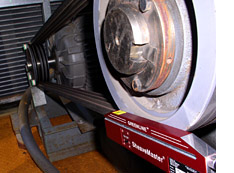
Properly maintained V-belt drives can be up to 97% efficient. Poorly operating belt drives can waste as much as 10% additional input power. Let’s consider a scenario that ignores motor losses and only considers losses in the belt drive. With electricity costs of seven cents per kWh, a rotor operating three shifts per day, five days per week, and requiring 50 horsepower from a belt-drive would consume over $16, 000 of power annually. An additional drop in efficiency of only 5% would result in increased costs of over $800 per year. In some industries, such belt drives may comprise more than 50% of the total drive population. This example clearly shows that big savings can be realized by properly maintaining them.
Read the entire article: Maintaining Belt Drives For Maximum Savings
by Bill Hillman CMRP
June 2010 · Uptime Magazine
When dial indicators, straight edges, and taper gauges were the only tools available for doing shaft-to-shaft alignment, machines were often left in a rough alignment condition. This happened because either too much time would need to be invested in order to obtain the required degree of precision or human error entered into the calculations. With the introduction of laser alignment tools, it has become a standard operating procedure to perform precision shaft-to-shaft alignment when machines are installed or reinstalled after a rebuild. Before the introduction of laser alignment tools, harmful soft foot conditions were often not addressed.
Read the entire article The Expected and the Unexpected – The Ever Increasing Benefits of Modern PdM Technologies
by Bill Hillman CMRP
April 2010 · Reliable Plant Magazine
It is common knowledge that technologies such as vibration analysis, shaft alignment, oil analysis, thermal imaging, motor circuit testing, and several other technologies are excellent tools to help achieve these results. These technologies can be used for the identification and elimination of machinery defects on a daily basis. Many facilities are content with the knowledge that machinery defects (bearing defects, gearbox defects, etc.) have been identified, scheduled for maintenance, and ultimately repaired utilizing these technologies. An optimized reliability program will constantly seek the root causes that create the machinery defects, thereby avoiding many chronic and recurring problems. Most facilities believe that finding the root cause of equipment defects can be difficult. This may be true in some cases, but it is not always the reality. In fact, many of the actual root causes of equipment defects can be easily identified. The elimination of these root causes will reduce the amount of equipment defects that must be repaired over time, help you achieve the goal of reduced maintenance cost, and increase profits at your company.
Read the entire article Do you want to increase profits and reduce maintenance costs for your facility?
by Trent Phillips
April 2010 · Wind Systems Magazine
The truer the shaft alignment, the lower the maintenance costs and longer the turbine life, but how can it be achieved? LUDECAwind has the answers. The world’s first electric power generating wind turbine was manufactured by Charles Brush in 1888, and it delivered 12 kW of power reliably for 20 years (Fig. 1). The battle to make wind energy economically viable has been going on ever since, and it must be fought on many fronts. One key element in the struggle for increased reliability and efficiency is achieving excellent shaft alignment of the wind turbine generator train. Is this an uphill battle for you?
by Ana Maria Delgado, CRL
October 2009 · IMPO Magazine
Unlike imbalance, misalignment does not produce forces that are similar in the radius of the machine. Vibration in one radial direction may be very different in amplitude when compared to vibration in another radial direction. This is one instance where amplitude readings are not only helpful in detecting a problem but also helpful in diagnosing a problem. Misalignment can result in a machine having high vertical vibration on one end and high horizontal vibration on the other with other radial readings remaining low. Imbalance is not likely to cause this amplitude pattern.
Read Vibration Due To Shaft Misalignment
by Ana Maria Delgado, CRL
February 2010 · Maintenance Technology Magazine
Going green is not something to be taken lightly. Not only is our livelihood at risk, but our very lives may also depend on how well we meet the challenges of living green. To cover all the benefits of going green would require multiple, book-length documents; therefore, we will limit this discussion to the green benefits of precision machine alignment. Precision alignment produces these types of benefits in four areas: energy savings, improved machine life, better products, and less pollution.
Read Go Lean and Green: Align The Machine
by Ana Maria Delgado, CRL
February 2010 · Pumps & Systems Magazine
Vertical pumps are designed to be “self-aligning” due to the rabbet fit between pump and driver, thus eliminating the need for precision shaft alignment. Notwithstanding these advantages, this article will focus on the need for the alignment of vertical pumps.
Read Are Your Vertical Pumps Throwing Money Down the Drain?.
by Ana Maria Delgado, CRL
March 2010 · Plant Services Magazine
During these tough times, industries attempt to cut all costs deemed not absolutely necessary for the day-to-day operation of the plant. Many times training budgets are among the first costs to be curtailed. This usually happens because the true value of training may not be fully understood, and training may not be seen as critical to company growth and profits.
by Ana Maria Delgado, CRL
April 2010 · Energy-Tech Magazine
The importance of training is often given short shrift in the industry when it is in fact a vitally important profit center for the business. A well-trained employee gets the job done better, faster, and cares more. An employee that has been well trained appreciates the fact that the company cares enough to invest in educating him or her. This in turn usually leads to the employee liking the equipment they’ve been trained on more and caring more about plant processes. Consequently, the trained employee does his or her job much better. Another resulting benefit is that the equipment is much better cared for. A case in point is laser alignment training.
by Ana Maria Delgado, CRL