
Anyone who has spent time in the field of machine repair has most certainly heard of “thermal growth”. This is the unavoidable act of materials expanding as they heat up or contracting as they cool down. Thermal growth is a well-known phenomenon that is dealt with extensively in alignment procedures. Components growing or shrinking with temperature change changes the offset and angularity of the shaft alignment and must be compensated for.
Thermal growth isn’t a concern for alignment crews only. It must be considered when setting up any machine or installing bearings on nearly any kind of machine. The reason for this is “Axial Growth” of a shaft. In other words, in addition to the radial positional changes caused by the expansion or contraction of the machine housings from thermal growth, the length of a shaft will also change with temperature changes.
If a shaft lengthens or shortens with temperature change, this must be considered when selecting the correct bearings to install on certain machines. Let’s break this down and give you a few things to consider before installing bearings on anything.
Consider the Temperature Change
The first question that must be asked is, how much temperature variation will the shaft be exposed to between the stopped, unloaded and ambient condition of the machine, and its fully loaded running condition? Some machines don’t see much variation at all. A good example of this would be a fan inside a climate-controlled office building or hospital. Other machines see drastic temperature variations. An example of those would be an oven circulation fan. When this machine is offline, the shaft is exposed only to ambient temperatures. But after being placed into service with heat in the oven, the shaft could be exposed to temperatures hundreds of degrees above ambient. The bigger the temperature changes, the more the shaft will grow and the more room the shaft will need to accommodate that growth.
What’s the big deal? Why worry about thermal growth?
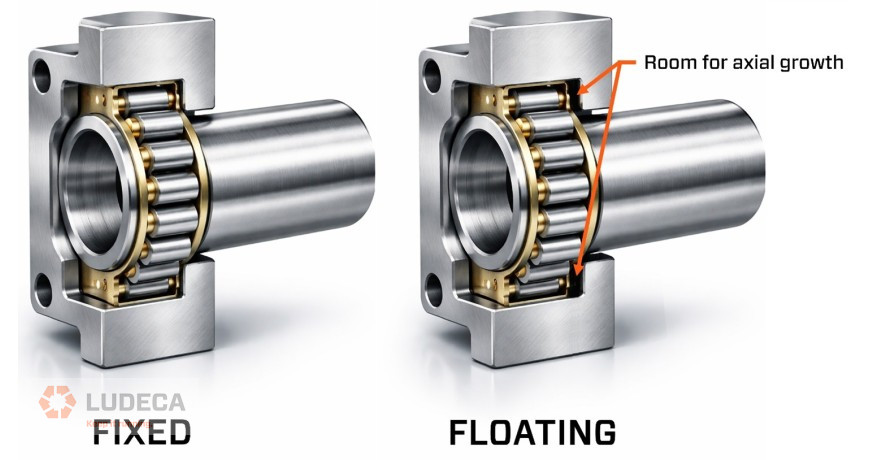
If we install two fixed bearings onto a shaft and bolt them down to a base, we have left nowhere for the shaft to go when it grows. In that case the shaft will bow or bend to accommodate its increased length, provoking potential imbalance vibration as well as unnecessary axial and radial loads on the bearings. This is where a floating bearing comes in. A shaft that experiences thermal growth should have one fixed and one floating bearing. The fixed will maintain the proper positioning of the shaft and the other will float inside its own housing, allowing the shaft to lengthen or shorten as needed. A shaft that is not allowed to lengthen or shorten freely will lead to excessive heat, vibration and premature failure.
How do floating bearings work?
A floating bearing has extra room inside the housing for the bearing to move in or out in the axial direction (ie. along the rotational axis of the shaft itself) as the shaft changes in length. The bearing is mounted to the shaft, and the housing is mounted to the base. The only thing that should move freely is the bearing inside the housing. The illustrations below show the difference between a fixed and floating bearing:
What kind of machines need Floating Bearings?
The simple answer to this question is any machine could experience significant axial growth of the shaft or of the machine housing that holds the bearings. It depends on the application and temperature variation. It is very important to remember the thermal growth rules for certain materials. Most shafts are made up of mostly carbon steel. However, some shafts are made up of stainless steel or other kinds of allows. Below is a chart of the most common alloys found in machines:
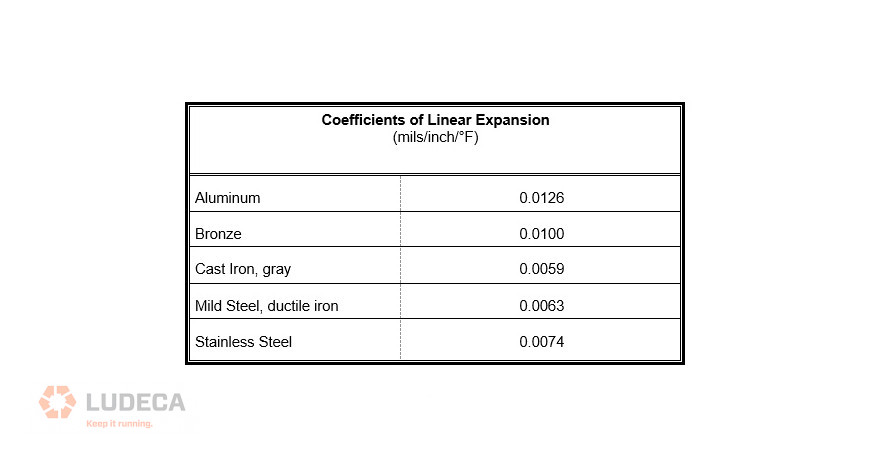
Formula for the calculation of thermal growth at the machine supports: T × L × C
Where:
- T = Change in Temperature (D°F).
- L = Distance of material involved (inches) (see Figure 16.).
- C = Coefficient of linear expansion (mils per inch of material per °F change in temperature)
This will tell you how much the material will grow per degree of temperature change.
Setting floating bearings, the right way
After deciding that a floating bearing is needed, the first thing we need to decide is which side of the machine should the floating bearing be mounted in? The drive end? Or the opposite drive end? There is no straight forward answer to that question. When placing the floating bearing on the drive end, you must consider either coupling gap, or belt alignment depending on how the machine is driven. Often times, it is better to place the floating bearing on the opposite drive end to avoid coupling gap or alignment issues.
However, the general rule of thumb when deciding where to locate the floating bearing is this: The floating bearing should be the one with the least amount of radial load. This allows the bearing to float freely without dragging and binding up. Sometimes it may be worth allowing some coupling float or sacrificing some belt alignment. Always use common sense and fully understand process parameters before making this decision.
The next thing we need to consider is, which way is the shaft or bearing going to go. In? or out? This depends on the temperature changes that the shaft will be exposed to when it is put into operation. If the shaft is going to be exposed to air or fluid that is hotter than ambient, we would want to locate the bearing favoring the inside of the housing to allow the shaft to grow. If the shaft is exposed to cold air or fluid, we would want to position the bearing toward the outside so the shaft can shrink. If extreme temperatures are expected both ways, it may be necessary to locate the bearing in the center of the housing. You must know the process to properly set up a floating bearing.
Conclusion
We hope this post has shed light on an often-overlooked issue. This is an issue that has destroyed bearings in their infancy more times than most would guess. Maybe now you can begin to set up machines to maximize working life. The goal is always to Keep It Running!
Watch our video Shaft Alignment Know-How: Thermal Growth to learn the importance of accounting for thermal growth on rotating equipment.
Filed under:
Alignment by Collin Mann