
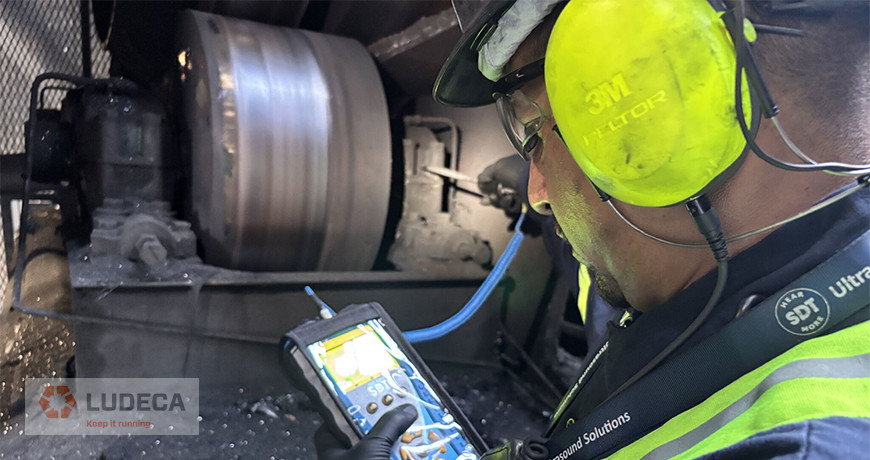
Why Ultrasound Works Best for Low‑Speed Bearings
Utilizing standard vibration analysis techniques when analyzing data on slow speed (<50 rpm) machinery can be especially challenging. The reason for this is that rolling element defect amplitudes are extremely small and are usually hidden in the accelerometer’s noise floor and can’t be seen using conventional techniques. Ultrasound gets around this limitation because it has a high-frequency sensitivity that allows for the early detection of Stage 1 rolling element defects.
Detection Techniques and Practical Tips
Listen to the bearing
- Audible anomalies: Utilizing a headset, the technician can listen to the sound that’s being produced between the bearing’s internal components. If the technician hears knocking, clicking or crackling sounds, a Stage 1 defect is indicated.
- At extremely low speeds (<20 rpm) the sound amplitudes being measured on the bearing being monitored can be below 0 dBμV.
- Healthy slow speed bearings register sound amplitudes from –1dBμV up to 4dBμV. These values are highly dependent on the machine’s operating speed; however, when a defect is present, the values will increase and climb towards the 0 dBμV threshold.
Time‑Domain Analysis
- Time waveform (time-domain) analysis is an invaluable tool when analyzing slow speed bearings. Periodic impacting caused by defect frequencies (e.g., BPFO {Ball Pass Frequency Outer}) even at low speeds can be identified relatively easily by looking at data in the time domain.
- Sufficient data must be captured for analysis. For a shaft operating at 15 RPM approximately 15–20 seconds worth of data is needed to capture a full 3–4 revolutions of the shaft to be able identify defects associated with the bearing’s outer race, rolling element or inner race. However, in order to identify a defect associated with the bearing’s cage, a measurement of 10–12 revolutions of the shaft is required, and in some extremely slow speed machines this could take several minutes.
Filed under:
Ultrasound by Dave Leach CRL CMRT CMRP