
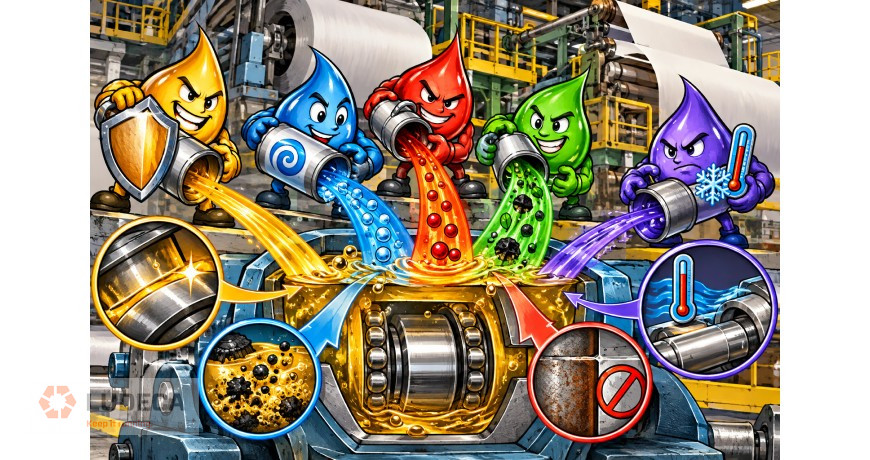
Additives play a significant role in letting us know when a lubricant is no longer useful. Additives are sacrificial by nature and once depleted the oil must be replaced or replenished again with the necessary additive(s). Oil analysis can be used to tell us when the oil is degraded and ready to be changed/replenished. Oil additives serve three functions: to enhance, to supply new properties, or to suppress undesirable properties in the base oil.
Oil Additives by Function
Anti Foam Agent (Defoamants): When fluid is moved quickly through a pumping action, it can entrain small air bubbles in the lubricant. These air bubbles are detrimental to a lubricant as air contains oxygen that will attack the base oil. Defoamants inhibit the formation of stable foams above the oil level in tanks, reservoirs and sumps. Defoamants are usually polymers such as methyl silicone or poly-methacrylate. They are dispersed as micro-globules in the oil, around 10 microns in size. These globules are pulled up as the air rises and then weaken the bubbles that form, causing them to burst.
Anti Oxidant Agent: Oxygen is base oil’s primary enemy, especially at higher temperatures when, in combination with contaminants such as water, it can lead to sludge and thickening viscosity, and the formation of tar, varnish, and corrosive acid within the oil and on the bearing surfaces. The rate of this process, called oxidation, is dependent upon the following factors:
- Aeration (affects the amount of oxygen available to react with oil molecules).
- Temperature (the rate of oxidation approximately doubles when the temperature increases by 10 degrees Celsius)..
- Water (causes hydrolysis and promotes oxidation).
- Metal catalysts (copper, lead, iron and other chemically active metals promote oxidation of oil; wear debris is the most prominent source of these catalysts).
Oxidative reactions change oil’s chemical and physical properties in the following ways:
- Increased viscosity (greater friction and resistance to component movement)
- Increased acidity (increased corrosion potential)
- Increased specific gravity
- Darkening oil color
- Varnish and deposits formation on component surfaces.
- Sludge formation
Demulsifier: Also known as emulsion breakers, are used where water contamination is expected, and are designed to chemically prevent the formation of any water/oil emulsion by altering the surface tension of the oil, thereby allowing the water to separate easily and be drained off. Detergents are used where combustion takes place to function as a chemical cleaner to keep combustion surfaces free from harmful deposits and to neutralize any combustion acids.
Dispersants: Used in crankcase and compressor oils, often in conjunction with detergents to chemically disperse and attach themselves to and suspend combustion and contaminant particles such as dirt, soot, glycol, depleted additives, and to allow them to be more easily trapped and extracted by the oil filtration system.
Dye: Used in transmission fluids and greases to better identify the product from other lubricants.
Friction Modifier: Long chain polar additives that have an affinity for metal surfaces are added to crankcase and transmission oils to reduce the surface friction of lubricated parts in an effort to increase fuel economy.
Pour point suppressant: Used to prevent the formation of wax crystals in paraffinic mineral oils at low temperatures, allowing the oil to remain pourable at lower temperatures.
Rust Inhibitor: Also known as a corrosion inhibitor, it forms a protective shield against water and corrosive acids to stop the formation of corrosion and rust on rust-prone ferrous metals such as iron and certain steels, and copper, tin, and lead-based metals.
Viscosity Improver: These employ long string polymers that expand as the oil temperature increases and serves to “thicken” the oil, or increase its viscosity.
Why is Lubrication One of the Primary Tools of Machine Maintenance? Let’s Find Out
Filed under:
Lubrication by Tom Cummings