
Uneven Heating = Distortion & Premature Failure
When heating is uneven, the Outer Diameter (OD) and Inner Diameter (ID) expand at different rates. This differential expansion can cause warping, ovality, improper shaft fit, increased vibration, and premature bearing failure.
Bearings must expand uniformly to slide onto the shaft without undue force. If the ID expands faster than the OD (or vice versa), internal stresses can occur, including crushing of rolling elements, pitting of inner and outer races, microfractures, and reduced service life.
Recommended Temperature Differential
- Ideal OD–ID difference: 18°–27°F (10°–15°C)
- Non-precision bearings: 27°–36°F (15°–20°C) maximum
Always consult the bearing manufacturer, as limits vary by bearing type.
Five Heating Methods & Their Pitfalls
1. Hot Plates
- Can develop hot spots.
- Require flipping the bearing for uniform heating.
- Uneven expansion risk.
- Requires additional PPE and presents burn hazards.
- Energy inefficient.
2. Ovens
- More uniform heating but slow.
- High energy consumption.
- Requires external temperature monitoring.
- Requires PPE.
- Heats entire bearing without selectivity.
3. Hot Oil Baths
- Fire and flash risk.
- Oil contamination of the bearing.
- Requires strict oil and bearing temperature control.
- Requires PPE.
- Environmental and housekeeping concerns.
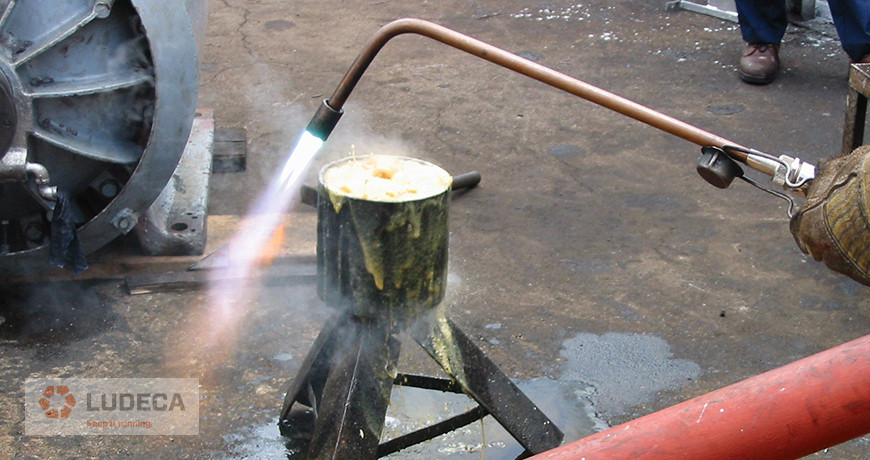
4. Open Flame (Never Recommended)
- Creates severe hot spots.
- Can exceed allowable temperature limits.
- Causes metallurgical damage.
- Destroys seals.
- Leads to immediate or latent failure.
5. Brute Force Installation
- Causes nicks and burrs.
- Leads to brinelling and raceway damage.
- Crushes rolling elements.
- Reduces bearing precision and life.
Special Note: Sealed Bearings
Sealed bearings are especially vulnerable. Direct heat damages seals, oil bath immersion degrades seals, overheating causes seal hardening, and seal failure leads to contamination and grease loss.
Induction Heating – Preferred Method (With Conditions)
Induction heating is one of the safest and most controlled methods, if properly equipped.
Minimum Essential Requirements
- Temperature control
- Automatic demagnetizing cycle
Failure to demagnetize a bearing allows it to attract airborne metallic debris, leading to raceway damage and premature failure.
Ideal Setup: Dual Temperature Probes
Using two temperature probes (one on the ID and one on the OD) allows monitoring of differential expansion, prevents overheating, maintains allowable temperature change, and protects internal geometry during installation.
An induction bearing heater capable of monitoring both probes, controlling maximum temperature, controlling maximum OD–ID delta, and providing automatic demagnetizing after heating represents best practice.
Download our Induction Heating Procedure plus Bearing Mounting infographic for a simple and safe procedure for proper bearing installation using induction heating!
Comparing Hot Plate to Induction Heating for Proper Bearing Installation
Filed under:
Induction Heating by Bernd Seidenthal CRL