
June 2010 · Uptime Magazine
When dial indicators, straight edges, and taper gauges were the only tools available for doing shaft-to-shaft alignment, machines were often left in a rough alignment condition. This happened because either too much time would need to be invested in order to obtain the required degree of precision or human error entered into the calculations. With the introduction of laser alignment tools, it has become a standard operating procedure to perform precision shaft-to-shaft alignment when machines are installed or reinstalled after a rebuild. Before the introduction of laser alignment tools, harmful soft foot conditions were often not addressed.
Read the entire article The Expected and the Unexpected – The Ever Increasing Benefits of Modern PdM Technologies
by Bill Hillman CMRP
Successfully persuading your management team about the importance of predictive maintenance requires a certain mindset, one that embraces the ideology that any failure in selling predictive maintenance lies within your selling techniques and not the management team. Success will simply depend on developing the proper selling methods. You are more likely to have success if you show management why they, not you, need predictive maintenance in the company. We have always heard that managers speak the language of dollars. This is true.
Attempt to avoid all technical reasons for justifying PDM and make good arguments based on savings and profitability. Reduced energy consumption, increased uptime, longer machine life, increased machine reliability, and improved products are just a few in a long list of items that will result from good PDM. However, just stating these items will not be very persuasive in your selling attempts. You must show how these benefits relate specifically to applications in your company and present dollar figures calculating the value added by the implementation of PDM technologies. Any data included with the dollar figures should be simple and easy to understand for a non-technical person. Trend plots, bar graphs, or pie charts are effective visual displays of such information. Your report should be concise but lengthy enough to convey relevant information. Brevity usually works best. If you don’t succeed on the first try, be persistent and improve your selling techniques. Remember, the fault lies in your methods and not with the management team. Luck is not a requirement for success. Only the proper arguments are required. Once the correct selling strategy is found, success is sure to follow.
by Bill Hillman CMRP
Several points should be checked prior to laser shaft alignment in order to avoid problems later and to achieve good results:
- Foundation: A solid, rigid foundation is essential for a successful alignment.
- Machine Mobility: It is advisable to set both machines with about 80 mils of shims underneath the feet in case one machine needs to be lowered. Also, jacking bolts provide a safer and more accurate way to make horizontal moves.
- Rigid Couplings: Must be loosened to achieve accurate readings.
- Coupling Play: This can be avoided by turning the shafts a few degrees before starting measurements and then taking readings in the same direction.
- Bearing Play: Check for excessive bearing play.
- Soft Foot: Check for and correct soft foot before performing a final alignment.
Soft foot can severely affect the operating condition of a machine, and will undoubtedly shorten its life expectancy. Here are a few simple tips to help avoid soft foot in your machines:
- Eliminate rust, dirt, and any other contamination from the contact surfaces of the machine feet, shims or foundation.
- Avoid using more than four shims at a time under the machine foot. More than three shims can cause a spring effect.
- Eliminate undue external forces on the machine frame such as those from connected piping, conduit, auxiliary supports, etc.
- Use high-quality, clean, and uniform shims when shimming is necessary.
by Ana Maria Delgado, CRL
Dowel pins in machinery have at least 3 functions. One function is to restrict relative movement and aid in the placement of two mating parts such as seen in bearing housing caps. Another function is to prevent improper orientation of components. Lastly, dowel pins are used to keep machine components in alignment. Our discussion will investigate this last function. Dowel pins are commonly seen on larger machinery. The dowels are usually placed in machine mounting feet or bearing housings. The intent is to prevent movement between these components and the base plate or foundation, thus keeping the machine train aligned. People rely on the dowel pins to maintain machine alignment and assume that if the dowel pins are in place the machine is aligned. During alignment checks, I have never found a doweled machine to meet the tolerances of a precision alignment. I recall one instance where a machine was precision aligned and after the alignment technician left the worksite the maintenance leader insisted on re-installing the dowel pins. Re-installing the dowel pins forced the machine back into a misaligned condition, so the previous efforts and expenses were a waste.
How should we approach the alignment of machines held in place with dowel pins? First, we should realize that proper machine mounting bolts when properly torqued are sufficient to hold machinery in place. The dowels should not be required if proper mounting fasteners and proper fastener techniques are used. When installing a machine with pre-existing dowels set the machine in place and re-install the dowels if you like. This will provide a starting point equivalent to a “rough alignment”. Now remove all the dowels except the machine component that you would designate as the stationary machine, remembering that this dowel may also have to be removed if, for some reason, the alignment process requires that this component needs to be moved. Proceed as with any other machine alignment. The component with the dowel left in place doesn’t really need the dowel and the dowel becomes only a point of reference.
Related article: Alternatives to using dowel pins in machine feet
by Bill Hillman CMRP
All laser shaft alignment systems should be able to take two sets of readings on well-built machines and find agreement at the coupling within 0.5 mils offset and 0.1 mils/inch angularity. It is important to always take two sets of readings immediately after setting up the brackets and compare the coupling results for repeatability. A good laser shaft system should have the capability of automatically recording the misalignment information for the user to compare for repeatability. If the readings do not repeat the problem may lie within the machines rather than in the bracketing or the shaft alignment tool itself.
Watch our Webinar: Laser Shaft Alignment: Repeatability & Accuracy Issues. Troubleshooting Your Readings.
by Ana Maria Delgado, CRL
Precision Alignment of electric motors coupled to pumps, compressors, gearboxes, blowers, etc.; contributes to savings in the consumption of electricity. Since all fossil power plant-generated electricity causes carbon emissions, the reduced electricity consumption also means LOWER RELATED CARBON EMISSION.
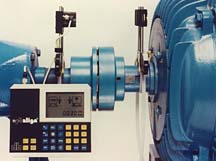
In 1984 the first pre-programmed Laser Coupling/Shaft Alignment tool was launched by our principals PRUEFTECHNIK Alignment. For already 25 years, our alignment tools are contributing to the GREEN movement. Not only does precision alignment contribute to going GREEN, but it also extends the life of Bearings, Mechanical Seals, and Couplings and extends the Mean-Time Between-Failure, thus saving money for parts and increasing production. All industries using pumps to transport hazardous liquids – and that means basically the entire chemical industry as well as refineries – have experienced leaking seals. Hazardous liquids contaminate the environment. Only well-aligned pumps guarantee that mechanical seals perform to perfection and that means avoidance of leakage, another area where Better Alignments help the GREEN movement. Every leaking seal or stuffing box in Water and Water Treatment plants is a waste of scarce resources. Only good alignment of motor-driven pumps will avoid leakage. Shaft/Coupling alignment contributes in more than one way towards great savings and a GREENER ENVIRONMENT.
by Dieter Seidenthal
For machinery installation, only the rotating shaft centerlines of different machines are aligned. Not the feet, not the coupling, not the shaft surfaces, not the machine housings, not the bearings; only the rotating shaft centerlines. It is important to understand that alignment refers to the positions of two centerlines of rotation or two rotational axes. Note that the shaft’s rotational centerline may be different than its machined centerline.
Shaft alignment means: Positioning two or more machines so that their rotational centerlines are colinear at the coupling point under operating conditions. Colinear means two lines that are positioned as if they were one line. Colinear, as used in alignment, means two or more centerlines of rotation with no offset or angularity between them.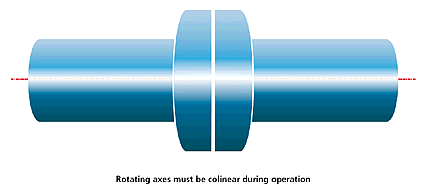
The phrase “coupling point” in the definition of shaft alignment is an acknowledgment that vibration due to misalignment originates at the point of power transmission, the coupling. It does not mean that the couplings are being aligned. The shafts are being aligned, and the coupling center is just the measuring point.” At operating conditions” is an acknowledgment that machines often move after start-up due to wear, thermal growth, dynamic load shifts, or support structure shifts. Besides the above considerations, the term shaft alignment also implies that the bearings and shafts are free from preloads. In properly installed equipment, there are no forces or strains on the bearings and shafts, except those the designers intended. If the machine is installed with the frame distorted because of uneven or imperfect base plates, bent feet, pipe stresses, or whatever, then machine life will be shortened, often significantly. The only way to determine rotational centerlines is to rotate the equipment. There is no series of measurements that do not involve turning the shafts between readings that can be used to find the rotational centerline.
If you don’t turn the shafts…Any system that takes so-called alignment measurements without turning BOTH shafts is aligning surfaces, not centerlines of rotation. The results of any alignment efforts where one or both shafts are not turned are highly dependent upon the surface quality, rotor eccentricity, shaft straightness, and other surface defects. In short: “If you do not turn the shafts, you are not doing shaft alignment.”
Related Blog: The 12 Rights for Precision Shaft Alignment
by Ana Maria Delgado, CRL
In a sense, this post is about one, and only one topic: MONEY. If alignment can be improved, the machinery failure rate drops dramatically. Equipment failures are a major maintenance expense and have numerous incidental or associated costs. In fact, the cost of parts and labor to repair the machine can be one of the smaller costs. Lost production, contractual penalties, consequential damages, and liability for injury can all be much more expensive than the repair itself. If half of the alignments in your plant are done with a straight edge and the other half with dial indicators, our experience tells us that the average misalignment in the plant will be about 15 mils (offset and angular misalignment, where the angular misalignment is expressed in mils/10″). This misalignment will create an average power loss of 0.842% (please note that this is a very conservative figure: there is a high likelihood of this value being significantly higher.)
For machines operating 365 days a year, 24 hours a day, at an average cost of energy of $0.06 per Kilowatt-hour, the Total Cost of Lost Power (TCLP) for a small industrial plant running up to 150 small to medium-sized machines (average of 35 HP) can be determined to be:
TCLP = 150 machines × 35 HP/machine × 0.7457 Kw/HP × 365 days/year × 24 hours/day × 0.00842 × $0.06/KwHour = $17,325.70 per year.
With precision alignment, it is possible to achieve an average misalignment of just 2 mils. This misalignment creates an average power loss of 0.041%. Thus, the new TCLP will be:
TCLP = 150 machines × 35 HP/machine × 0.7457 Kw/HP × 365 days/year × 24 hours/day × 0.00041 × $0.06/KwHour = $843.65 per year.
Therefore, the reduction in Cost of Power is: $17,325.70 – 843.65 = $16,482.04.
These savings easily pay for a new laser alignment system in one year, without taking into consideration all the other attendant benefits from the reduction in misalignment, such as reduced vibration resulting in improved product quality, greater manufacturing output efficiency, and reduced wear and tear on the machines with the consequential reduction in labor, repair, and spare parts expenses. Add to this the reduction in unscheduled downtime and the savings become almost incalculable.
by Ana Maria Delgado, CRL
April 2010 · Wind Systems Magazine
The truer the shaft alignment, the lower the maintenance costs and longer the turbine life, but how can it be achieved? LUDECAwind has the answers. The world’s first electric power generating wind turbine was manufactured by Charles Brush in 1888, and it delivered 12 kW of power reliably for 20 years (Fig. 1). The battle to make wind energy economically viable has been going on ever since, and it must be fought on many fronts. One key element in the struggle for increased reliability and efficiency is achieving excellent shaft alignment of the wind turbine generator train. Is this an uphill battle for you?
by Ana Maria Delgado, CRL
October 2009 · IMPO Magazine
Unlike imbalance, misalignment does not produce forces that are similar in the radius of the machine. Vibration in one radial direction may be very different in amplitude when compared to vibration in another radial direction. This is one instance where amplitude readings are not only helpful in detecting a problem but also helpful in diagnosing a problem. Misalignment can result in a machine having high vertical vibration on one end and high horizontal vibration on the other with other radial readings remaining low. Imbalance is not likely to cause this amplitude pattern.
Read Vibration Due To Shaft Misalignment
by Ana Maria Delgado, CRL
February 2010 · Maintenance Technology Magazine
Going green is not something to be taken lightly. Not only is our livelihood at risk, but our very lives may also depend on how well we meet the challenges of living green. To cover all the benefits of going green would require multiple, book-length documents; therefore, we will limit this discussion to the green benefits of precision machine alignment. Precision alignment produces these types of benefits in four areas: energy savings, improved machine life, better products, and less pollution.
Read Go Lean and Green: Align The Machine
by Ana Maria Delgado, CRL
February 2010 · Pumps & Systems Magazine
Vertical pumps are designed to be “self-aligning” due to the rabbet fit between pump and driver, thus eliminating the need for precision shaft alignment. Notwithstanding these advantages, this article will focus on the need for the alignment of vertical pumps.
Read Are Your Vertical Pumps Throwing Money Down the Drain?.
by Ana Maria Delgado, CRL