
Some coupling manufacturers will sell couplings claiming that the coupling can take a large amount of shaft misalignment. While this is true for most good quality flexible couplings, this capability can be easily misinterpreted. Flexible couplings are designed to withstand, without damage, some shaft misalignment. Sometimes it is perceived that, since the coupling can take the misalignment, the machines can run under this condition without any consequences. When running machinery with significant shaft misalignment, bearing and seal life will be impacted, resulting in premature failures along with other types of machine damage. This difference is not due only to coupling manufacturers’ generosity; there is a valid mechanical reason for building flexible couplings that can withstand much more misalignment than what is good for the machinery they connect: this “extra” misalignment capacity allows certain machines to be deliberately misaligned in the unloaded “cold” and stopped condition to allow for the changes that will occur in the alignment as the machines are set to run and arrive at the fully loaded “hot” and running condition, and account for dynamic load shifts as may occur. This deliberate misalignment is called alignment to target specifications, and LUDECA offers a number of ways of determining what these might be. If the good quality flexible couplings would not have this additional misalignment capacity, some machines could never be “short coupled” together and would require a long spacer shaft between them to allow for the thermal growth or dynamic load shifts. Now then, with that said, we reiterate that the fact that a good coupling allows for lots of misalignment is never an excuse for you to allow such excessive misalignment to exist between your machines in the running condition.
The table below shows some key differences between the two sets of tolerances.

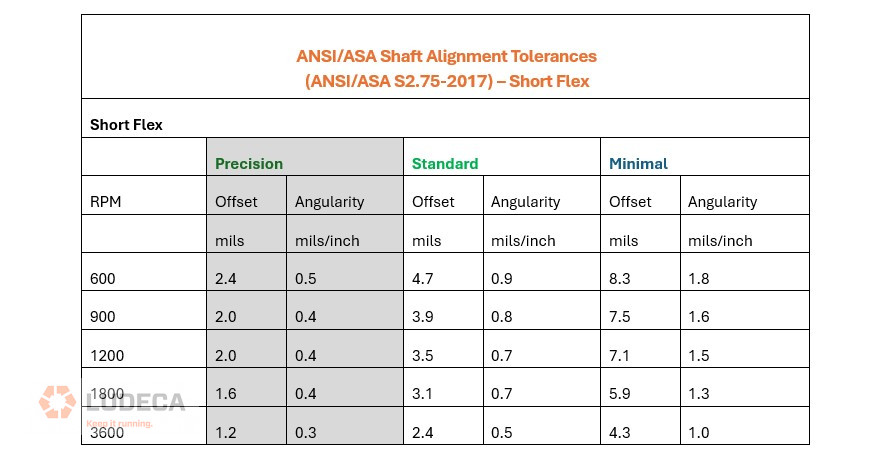
Therefore, for longer machinery life, it is always recommended to have the equipment laser aligned to standard industry tolerances such as (ANSI/ASA S2.75-2017), and not to the looser alignment tolerances allowed by the coupling manufacture itself. See tables 2 & 3 below.

Are Coupling Manufacturer Tolerances Good Enough for Shaft Alignment?
Filed under:
Alignment by Carlos Bienes CRL