The use of acoustic imaging cameras is expanding because more teams now face the same operational problem in very different settings: they know something is wrong, but they still need to locate the source quickly, from a safe distance, and with enough visual evidence to act on it. That pattern shows up in compressor rooms, substations, EV assembly lines, composite shops, hazardous areas, and engineering labs alike.
What makes acoustic imaging useful across industries is not that it replaces every existing test. It is that it helps narrow the search space. When a technician, engineer, or reliability team can see where airborne sound energy is concentrated, troubleshooting usually becomes faster, more repeatable, and easier to document.
This article is an application map rather than a product roundup. It covers the 10 workflows where acoustic imaging cameras tend to create the clearest operational value, then compares which deployment model fits which kind of job. If you want a fundamentals refresher first, start with What Is an Acoustic Camera? and How Acoustic Imaging Works.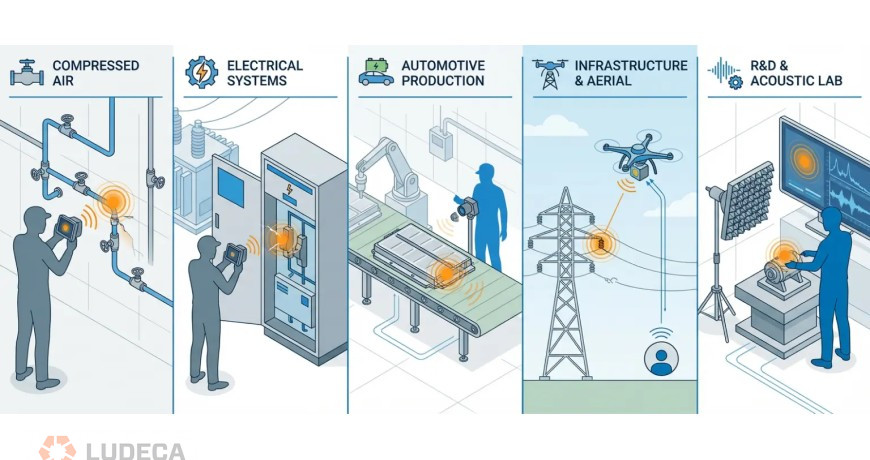
What acoustic imaging cameras do best
Acoustic imaging camera: a microphone-array-based inspection tool that turns airborne sound into a visual map, helping teams localize likely leak paths, discharge sources, abnormal noise, or other acoustic anomalies more efficiently.
In practice, acoustic imaging is strongest when teams need three things at once: localization, scan efficiency, and visual confirmation. Instead of checking one point after another, the operator can scan a wider area and see where sound energy is likely concentrated. That changes the troubleshooting workflow in a meaningful way, especially when manual search time is more expensive than the final validation step.
That last point matters. Acoustic imaging does not replace every certified or process-critical confirmation method. In leak-tightness work, teams may still rely on pressure decay, tracer gas, or immersion testing. In electrical maintenance, they may still need established diagnostic and safety workflows alongside acoustic surveys. The value of acoustic imaging is often that it makes those workflows faster by showing where to investigate next.
Interpretation also matters. Reflections, beamforming artifacts, and site geometry can influence what appears on the display, especially in reflective or crowded environments. That is one reason it helps to pair practical application knowledge with basic method knowledge, such as the guidance in Acoustic Imaging False Positives: Reflections, Beamforming Artifacts, and How to Avoid Them.
How to read this top 10 list
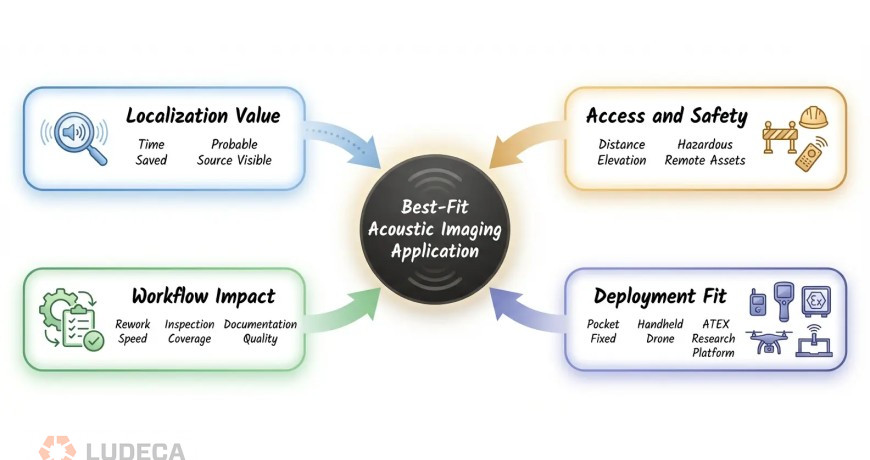
This list is not ranked by market size. It is organized around where acoustic imaging usually produces the clearest workflow benefit. We used four filters:
- Localization value: Does seeing the probable source area save meaningful troubleshooting time?
- Access and safety: Is distance, elevation, or environment making direct inspection harder?
- Workflow impact: Does the result improve rework speed, inspection coverage, or documentation?
- Deployment fit: Is there a clear match between the use case and a handheld, ATEX, fixed, drone-mounted, or research-oriented system?
That framing helps keep the discussion practical. Acoustic imaging is not equally useful for every sound-related task. It tends to win where conventional methods can confirm that a problem exists, but still leave the team asking where the issue actually is.
Thanks to Crysound for sharing this educational blog! Click to continue reading, here’s a preview of what you’ll find:
- The top 10 applications
- Which deployment model fits which application?
- FAQ
- Conclusion and next step
Filed under:
Ultrasound by Diana Pereda